
By Stephen D. Bowling
Many people smiled when they read the news.
On June 18, 1991, the Jackson City Council voted to end the practice of requiring drivers who parked regularly on the streets of Jackson to purchase and display a “City Sticker.”
The small vinyl sticker, whose color changed each year, was affixed to vehicle windshields to prove that the annual parking fee had been paid to the city. Those vehicles that were parked without one received a bright red gift from a city policeman.
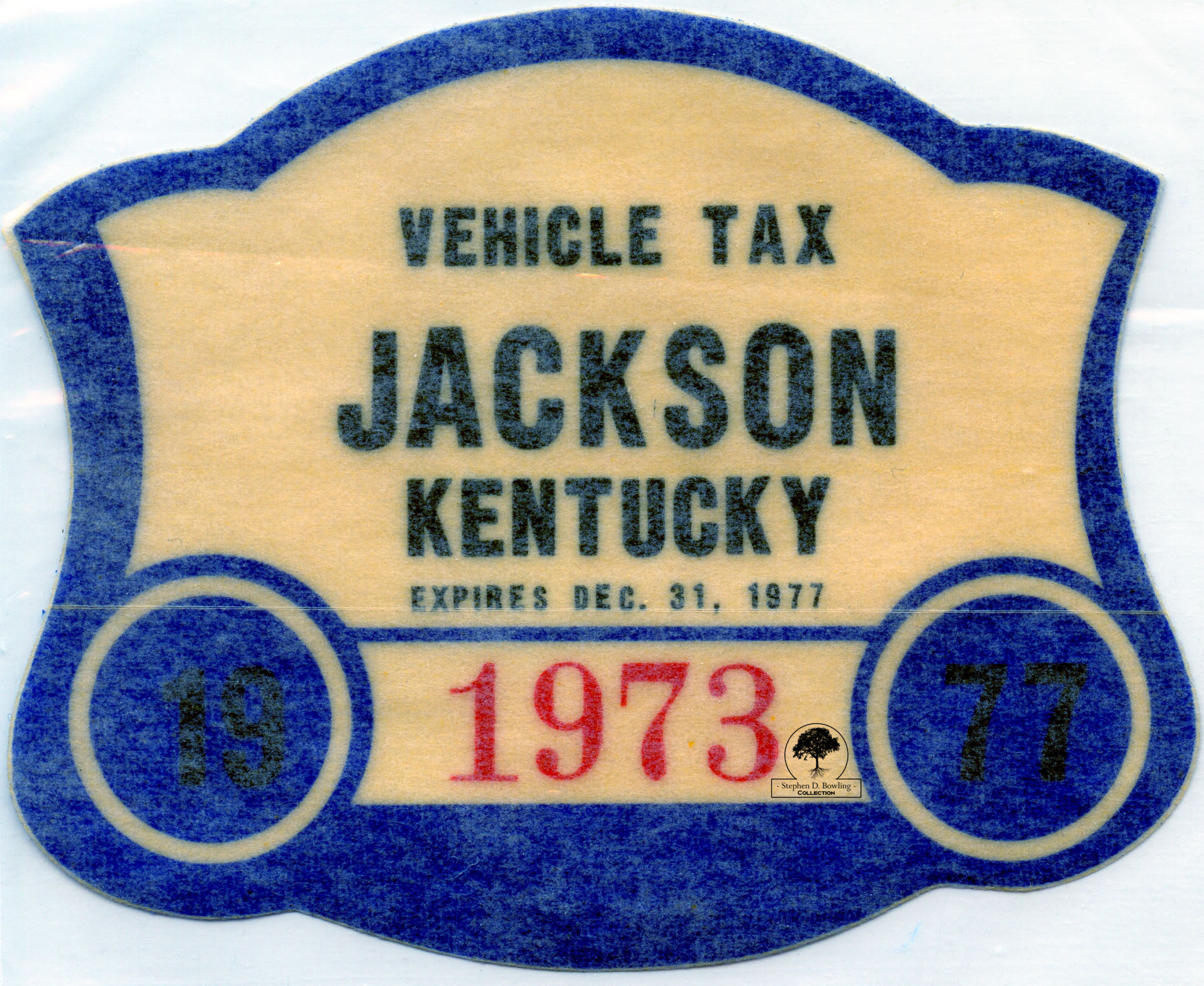
Delores Chandler, of The Jackson Times, wrote in her front-page story that Mayor Lester Smith had made a “pleasant announcement” that the $10 stickers would no longer be required. Chandler explained that the city had removed the line item for revenue from the sticker from the city’s budget.
The repeal of the ordinance marked the end of the 28-year tradition of parking stickers in the City of Jackson.

In December 1962, the Jackson City Council sought ways to increase the city’s revenues. At their meeting on December 3, they said they were taking “cognizance of proposed expansion, future developments and accompanying increased costs of operating the municipality.” Council members Clyde E. Bays, Bernard Noble, Virgil Barnett, Omer Hatton, Manuel Strong, and William T. Spencer attended the meeting to discuss the proposed new tax. Mayor Braxton Cox Short gaveled the meeting to order, and the debate started.
After approving the minutes from the November 5, November 20, and November 21 meetings, the Council approved the city’s property tax rates, voted to purchase a load of gravel, set the building inspector’s salary, and set a curfew for the city.
The council discussed the proposal to tax all vehicles in the city and to raise occupational taxes. The members voted unanimously to approve a motion to “underwrite the anticipated demand for greater expenditure by enacting two major cash-raising ordinances.”
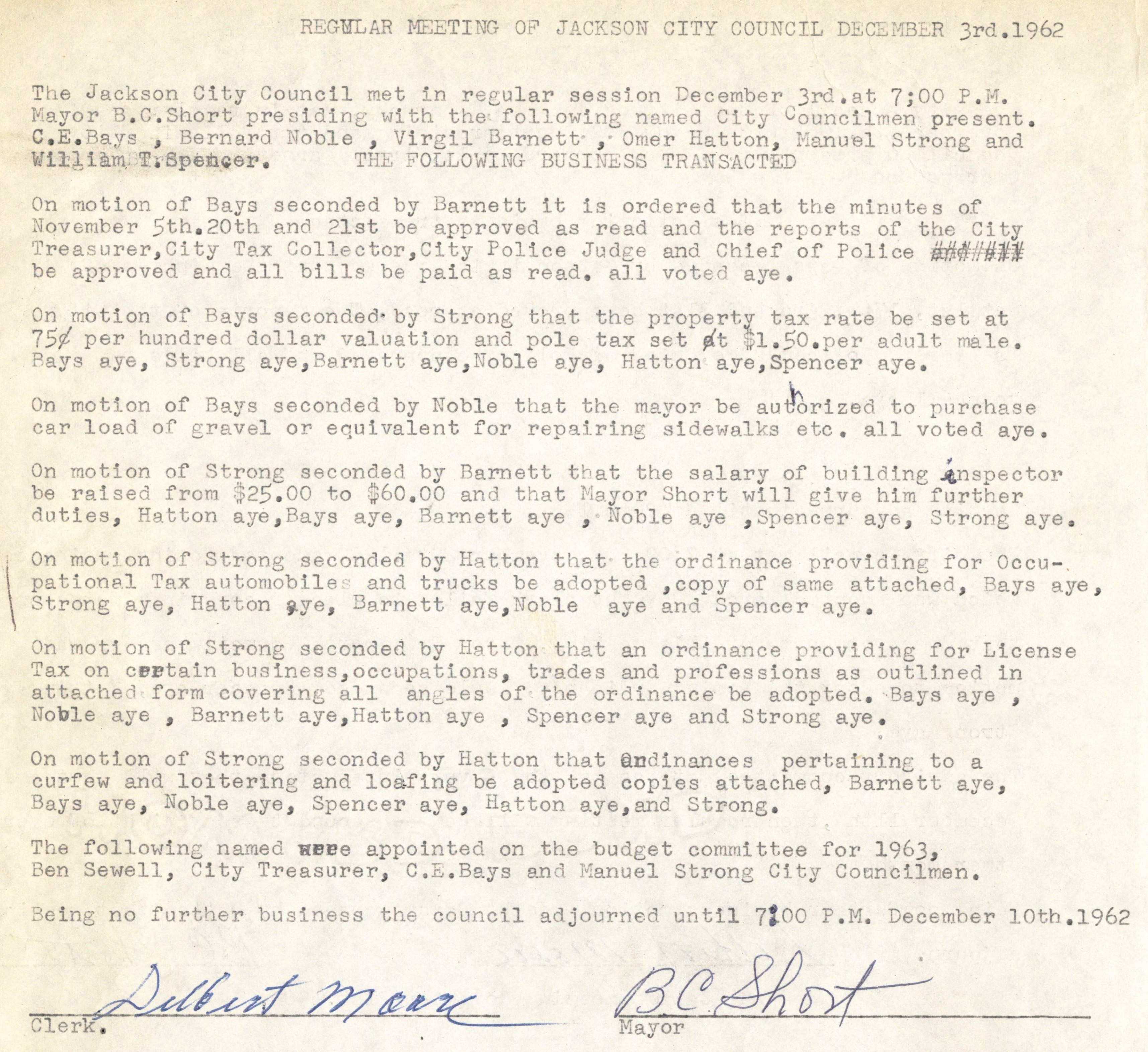
In short, the council passed an “across-the-board” increase in occupational license taxes paid by local businesses and created a new tax on every vehicle in the city.
According to the ordinance, the new license tax was set for all “automobiles and trucks owned by persons, firms, and corporations, living or located within the city, and on automobiles and trucks owned by persons, firms, or corporations residing or located outside the city but used in connection with a business, trade, or profession conducted, engaged in or practiced, within the city.”
The ordinance, set to go into effect on January 1, 1963, established a fee for each vehicle at $5.00 and provided that a windshield sticker, issued by the city clerk or tax collector, must be “permanently affixed” and displayed in the vehicle. The council also set a rate of $3.50 per sticker issued to a business with a current city business license. A penalty schedule was adopted, and the price of a sticker increased by $2.50 after March 1, 1963, with an additional $1.00 increase for every 30 days.
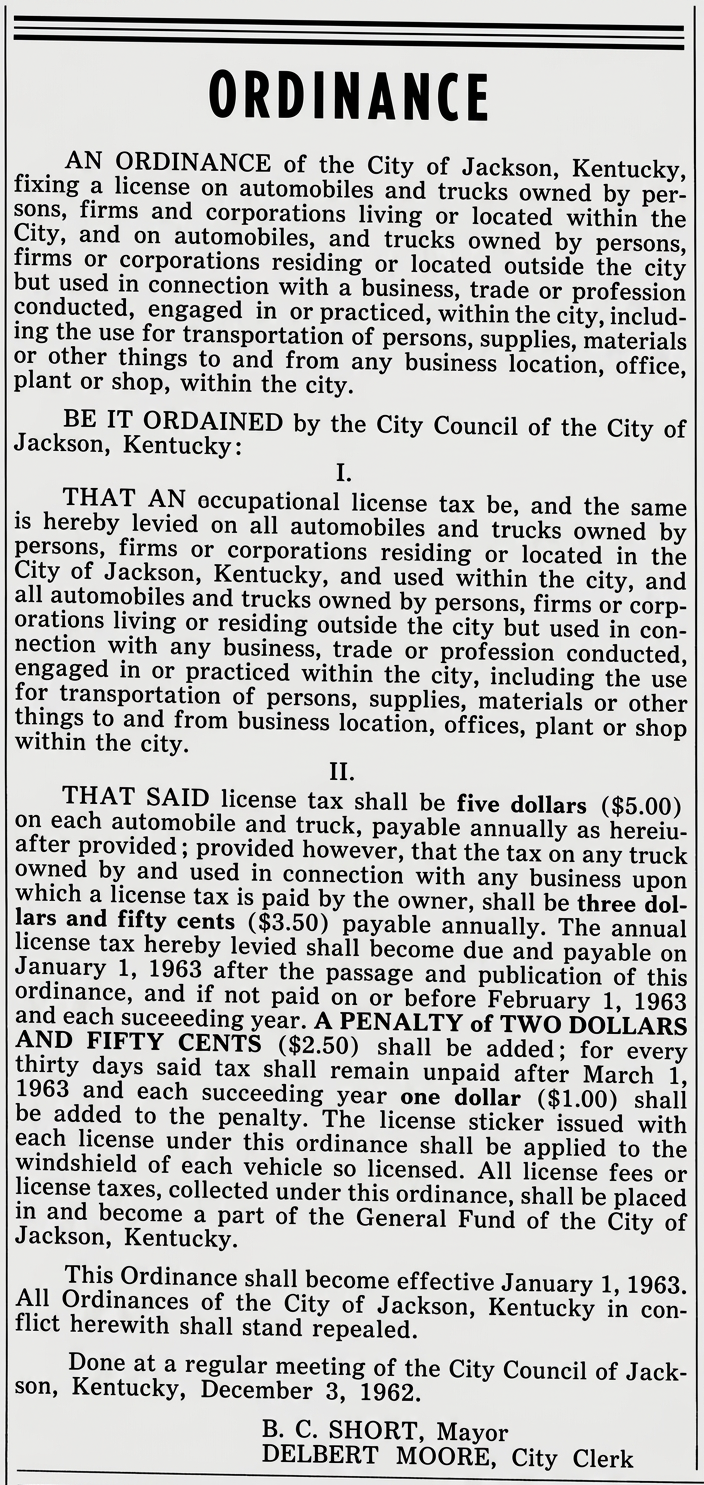
The council published the “Auto Sticker” ordinance in the December 6, 1962, edition of The Jackson Times and met again on December 10 to finalize the ordinance with a second reading and a unanimous vote. No opposition was noted or at least printed in the newspaper.
Tuesday, January 1, 1963, was a cold day, with the temperature hovering just below freezing, reaching about 27 degrees at 4:00 p.m. A steady wind made it feel cooler. As Jackson residents huddled close to their warm hearths, the Jackson Auto Sticker Ordinance took effect at midnight.
Sticker sales were steady in December and picked up in January. By early January, officials reported that only about thirty percent had complied with the required sticker purchase.
The City Council expressed its displeasure with the number of residents who had not complied with the new tax ordinance. At its May 6, 1963, meeting, the Council decided on “firm steps” to collect the new tax.
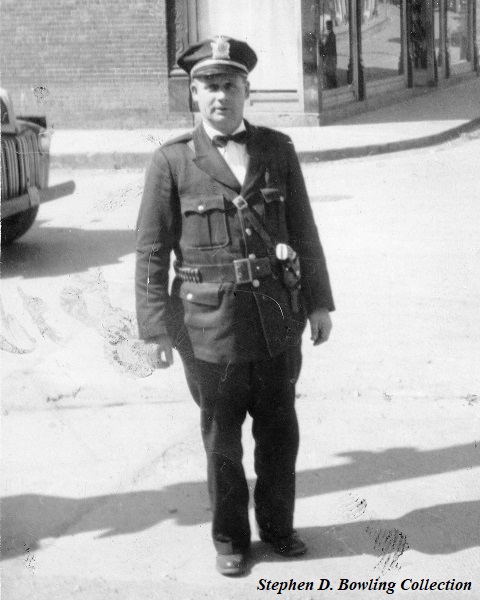
The Jackson Times announced on the front page of its May 9 edition that the council was offering “heavy financial penalties, embarrassment, and possible police fines” for those remaining residents who had “refused or neglected” to purchase their sticker.
The council unanimously set May 31 as the final deadline to purchase the tax sticker, and those who did not would be declared delinquent on that date, referred to the Jackson Police Court for action.
The city sticker program fared no better during its second year of operation. By April 1964, City Tax Collector Mize Hensley reminded residents that the Jackson Police Court could issue warrants, compel appearances in court, and issue fines and penalties ranging from $5.00 to $20.00 for those who failed to register their vehicles.
Mayor Braxton C. Short announced in April 1964 that the first cases for delinquents would be submitted to the Police Court at 8:00 a.m. on May 1. He extended the hours of the tax office to accommodate those who had not paid the license tax, which he said was “fewer than half of those persons required by law.”
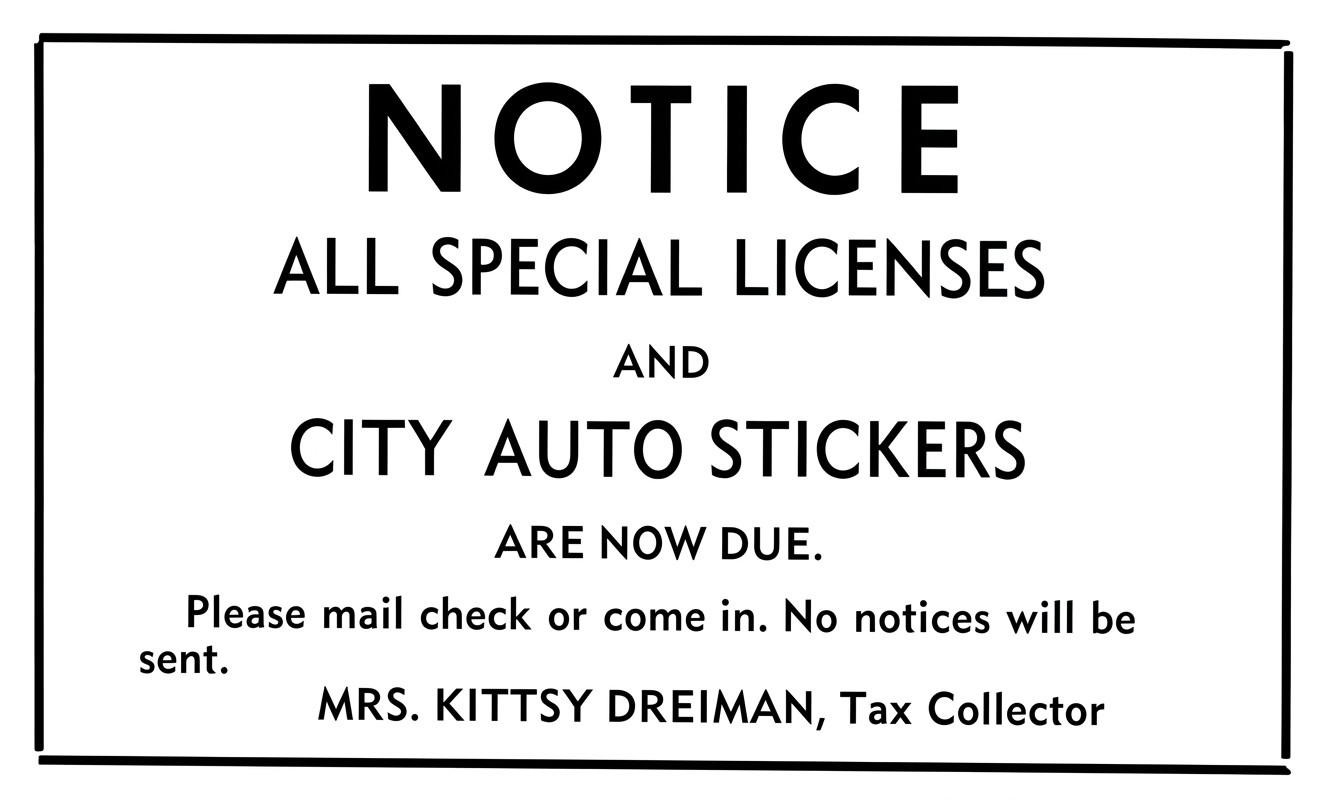
In subsequent years, warnings appeared in the local paper, threatening prosecution and towing for vehicles that failed to comply with the ordinance. City officials extended the purchase period in 1965 due to prolonged inclement weather, but the extra time did not help. Jackson Tax Collector Kittsy Dreiman reported in February 1965 that at least 300 Jackson residents were delinquent.

The city benefited from the sale of auto stickers, and in 1967, an estimated $5,173 was raised from their sale. The total paled in comparison with the $25,628 raised from paid parking meter use and fines.
Over the years, collection rates improved as residents failed to “embrace the revenue source.” The Jackson City Council announced a “Get Tough” plan in January 1971. Council members said they knew people who bragged about never having purchased a sticker and about evading prosecution. The Council, after discussing issues with the sticker program, voted to “crack down” on the estimated 200 residents who were not in compliance.
Jackson Police Chief Bill Miller told the council that it was “almost impossible” to catch everyone who had not bought a sticker and issue citations. ‘They will lie to you and everything to keep from it,” he said.

The crackdown included roadblocks at night and during the day, walking street patrols, and a call line to report noncompliance. The Council moved the chief back to the day shift to help enforce the ordinance and raised the maximum fine from $20 to $25.
The council’s efforts saw some success. Police Judge Kelly New later reported that the city had sold 703 stickers in 1970 and had reached 987 by February 1, 1971.
In January 1977, the price for a Jackson auto sticker and license tax on every vehicle rose from $5.00 to $10.00
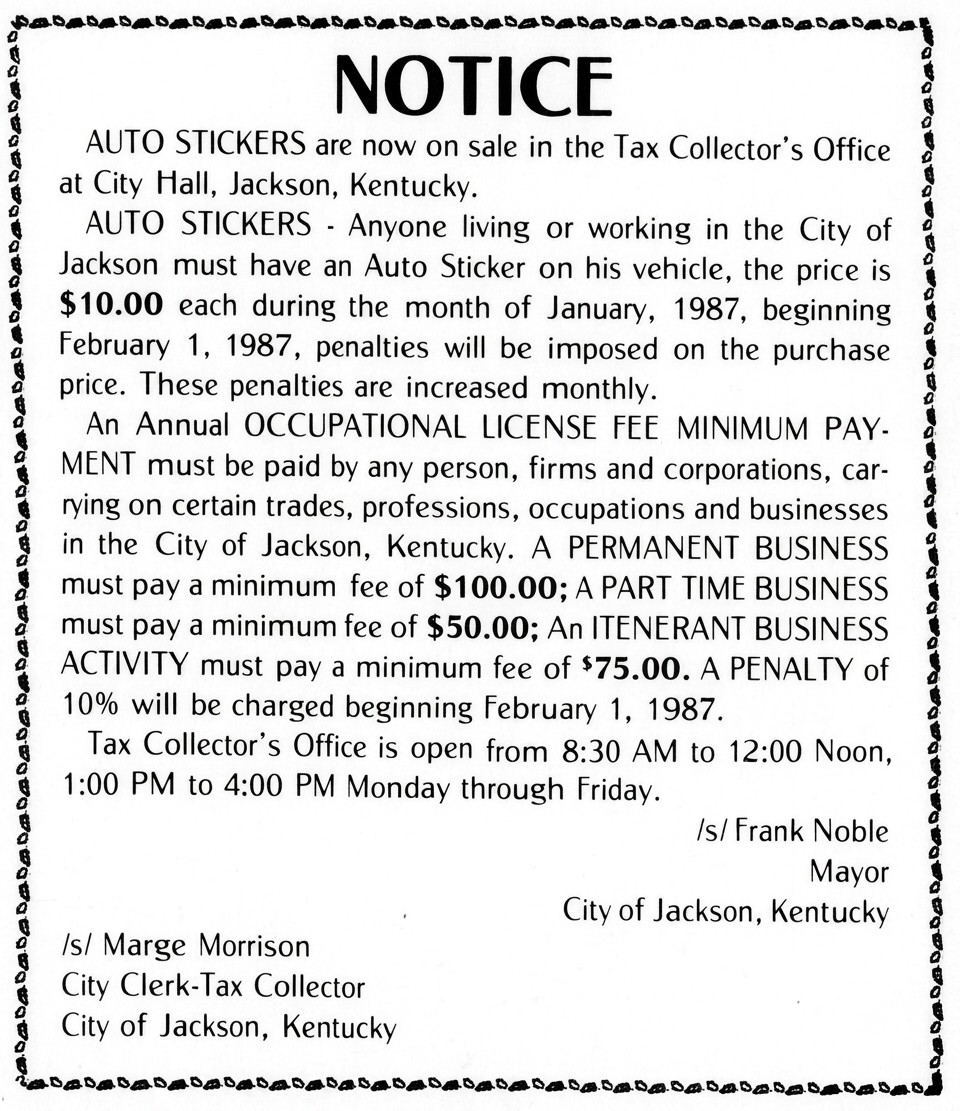
By 1984, the city auto sticker program accounted for approximately $14,300 of the city’s annual budget. By 1990, it represented an estimated $22,609 infusion of cash to the city’s coffers.

In 1991, Mayor Lester Smith reported that the city had issued 1,600 stickers and that business licenses had increased by 20 over 1990. He reported that more than 125 parking-sticker violations had been issued in the first four months of the year.
It was a shock when Mayor Smith announced in June 1991 that he would end the sticker program. Most residents said they did not believe that the program would end. The Council gave its ascent, but no formal vote was taken, according to Jackson City Council minutes. It was official, the controversial tax program simply ended with a whimper, and no more parking stickers were issued in the city of Jackson.
The Auto Sticker Program proved to be an “unmanageable mess” according to a former city official. It is estimated that the sticker system saw its highest participation in the mid-1980s, as Jackson grew and expanded to the “new road,” but may never have topped the 70% compliance plateau.
An occasional green, blue, or red sticker can be seen on the window of an old vehicle parked in the shade, but the Jackson Auto Sticker ordinance and the “city stickers” it created are now just memories.
© 2026 Stephen D. Bowling


