Compiled from various sources by Stephen D. Bowling
During the April hike, many admired the beautiful display that early Spring provided along the trail. Flowers of every size and color made their appearance and helped add variety to the brown, leafy floor of the forest.
Several years ago, the Sheltow Trace Association started production of a new trail guide. I wrote some of the history of the trail we walk upon, but we did not do much with the natural environment around us, primarily due to space limitations. To help remedy that deficiency, I have prepared a look at some of the flowers and plants that we will most likely see along our May hike. I hope you will enjoy the beauty the flowers add to your little walk in the forest.
Common Blue Violet
Viola sororia
April to May
The Common Blue Violet is a perennial plant in most states east of the Mississippi River. It grows abundantly in the rich mountain soil along the Rocksastle and Cumberland River sand in the foothills of the Appalachian Mountains. It is also known as wooly blue, meadow violet, hooded violet, and wood violet.


Yellow Trout Lily
Erythronium americanum
March to June
The Yellow Trout Lilly is a very common flower in early Spring, with six large yellow petals on each flower. The Lilly is a perennial, colony-forming flower that blooms in the months before the trees regrow their leaves and when direct sunlight is most available. When the canopy fills in, the Trout Lilly drops its bright flowers and waits for another chance to bloom the following Spring. There is a slight chance that we might see some along the trail in May- a slight chance.
Dutchman's Britches
Dicentra cucullaria
March to May
The short life span of the Dutchman's Britches is far outweighed by its beauty.  Often difficult to locate, this white flower floating in the wind above the bright green leaves can occasionally be seen along our hike.  The short-lived bloom was named after the white flower that resembles a pair of upside-down men's britches or, some say, under drawers.  The plants will often grow in number in a nearby area where ants have carried the seed away.  Keep your eyes open for this elusive plant bloom that will be saying a fond goodbye this year by the time we get into the woods in May.

Source: Wikipedia
Dame's Rocket
Hesperis matronalis
April and May
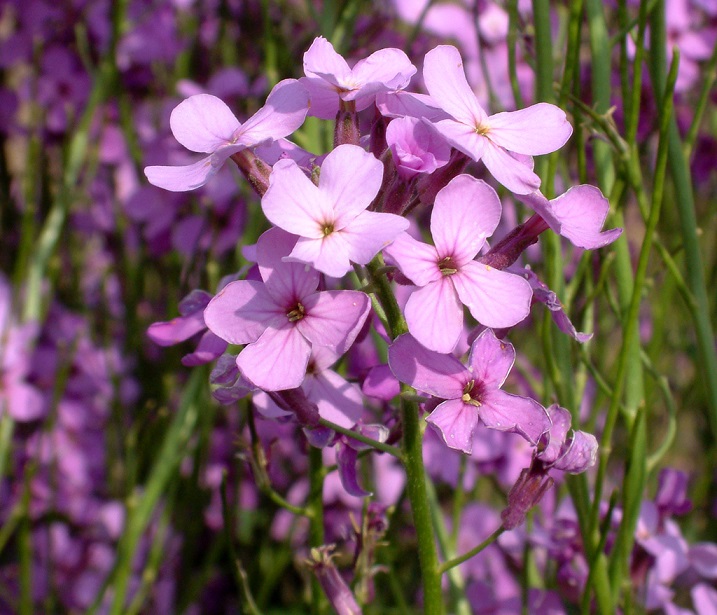
Dame's Rocket is a delicate herbaceous plant that produces a small pink flower from April to June on a biennial cycle.  The flower is sometimes called a Dame's Violet or a Dame's Wort.  From bloom to flower death, the Dame's Rocket lasts only a few weeks in mid-Spring and tends to grow in groups.  The young leaves (high in Vitamin C) can be used for salads if collected at the right time early in the season while the leaves are still tender.
Showy Orchid
Galearis spectabilis
April to May
The Showy Orchid is typically a small pink and white flower that grows in most of the eastern United States (except Florida) and as far west as Nebraska. As a sun lover, the flower usually blooms in early Spring and absorbes as much sun as it can before the leaves of the canopy above block the daily rays. The delicate flowers grow best in near succulent conditions and reach about 8 inches tall. Early-season bumble bees are the flowers' primary pollinators, using large leaves to land and gather nectar. While endangered in Main and several other states, the flower grows well in the rich, fertile soil of the Kentucky mountains.

Jack-in-the-Pulpit
Arisaema triphyllum
April to June
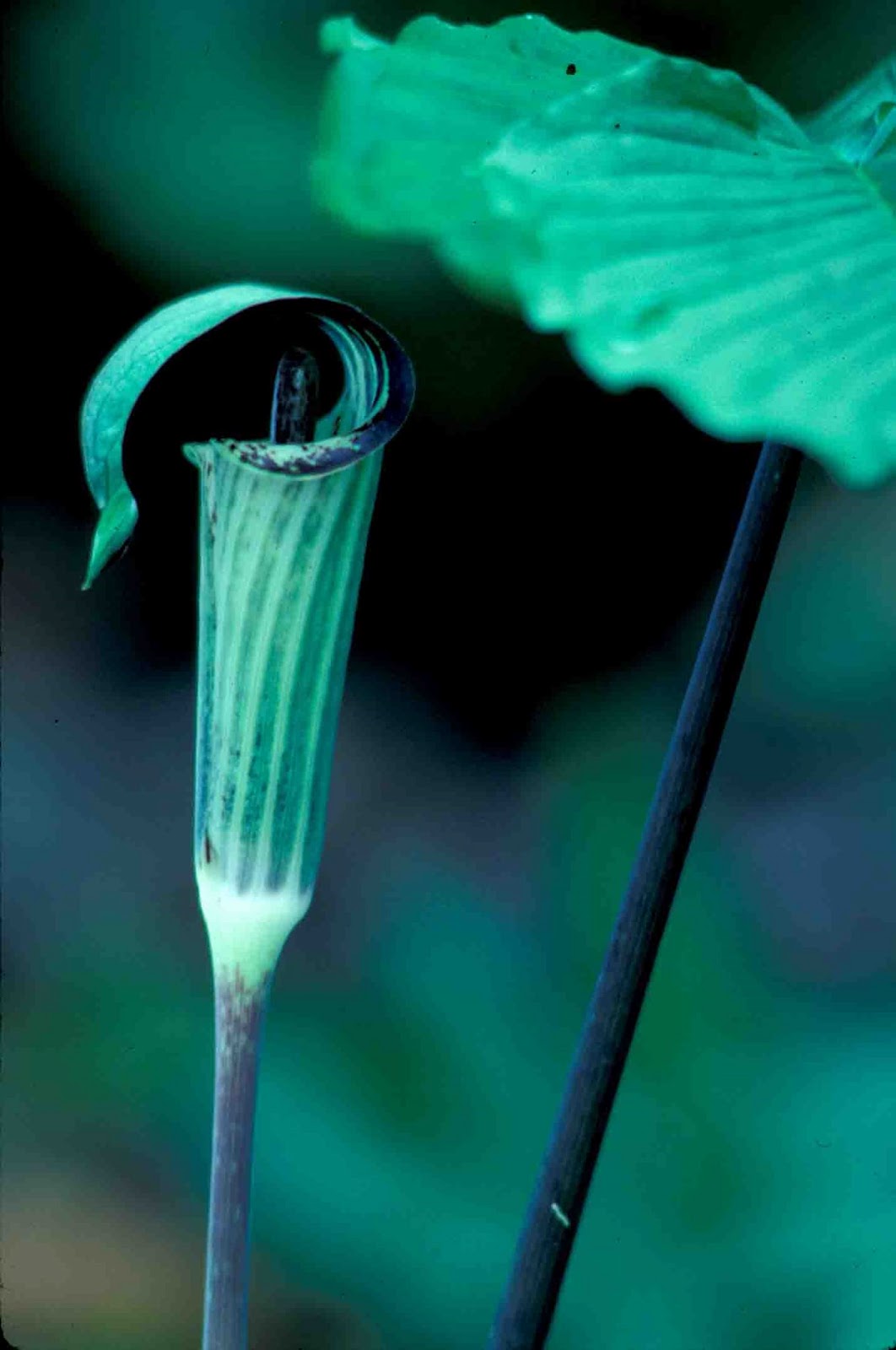
The Jack-in-the-Pulpit is one of the most elusive plants along our hike route. This rare and beautiful flower has a unique structural design, and flower hunters must look carefully to find Jack well hidden inside the body of this plant. The green and brown colors outside the spathe camouflage the spadix. Don't let this little beauty fool you. While the fleshy and tubular portion of this flower is eaten by many animals in the forest when they are ripe, the plant is one of the most poisonous in the mountains of Kentucky to humans if eaten. Be sure to photograph this shy and recessed plant if you see one.
Wild Geranium
Geranium maculatum
March to June
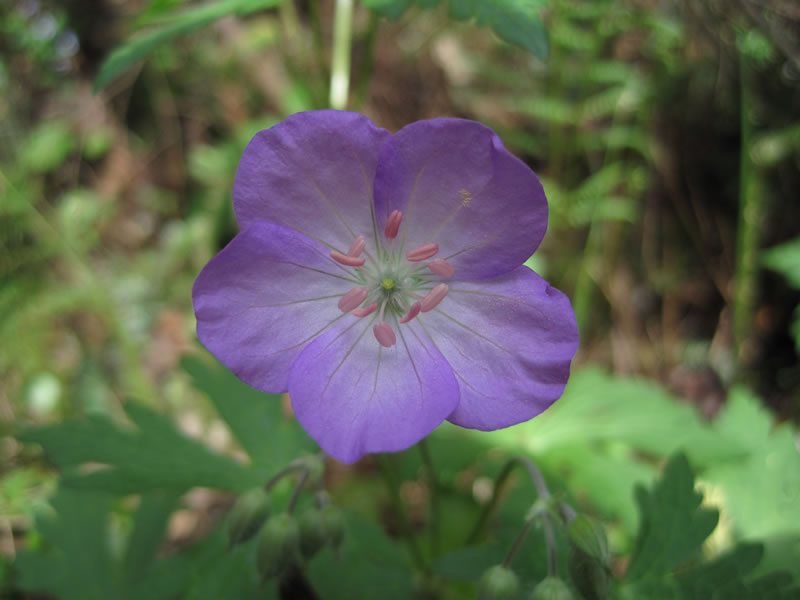
The Wild Geranium is one of a variety of 50 plants from the Geraniaceae family that grow in North America.  Common along the Sheltowee Trace, the rose-purple flower of the Wild Geranium.  The geranium blooms from a long plant stem that grows horizontally and produces nodes from which come new plants.  According to the USDA, the plant grows in "rich forests, fields, meadows, and thickets."

Azure Bluet
Houstonia caerulea
March to June
The small bluish-white flowers of the Azure Bluet can be seen all along the Sheltowee Trace from its northern terminus into the Big South Fork.  It is possibly the most common flower hikers will encounter along our path.  The nectar-rich flower attracts bees and other pollinators with its small four-petaled flower with a yellow center.  The Azure Bluet belongs to a family of small flowers (Rubiaceae) that grow in large colonies from Canada to Florida and as far west as Wisconsin.
Leafy Blue Flag
Iris brevicaulis
April to May
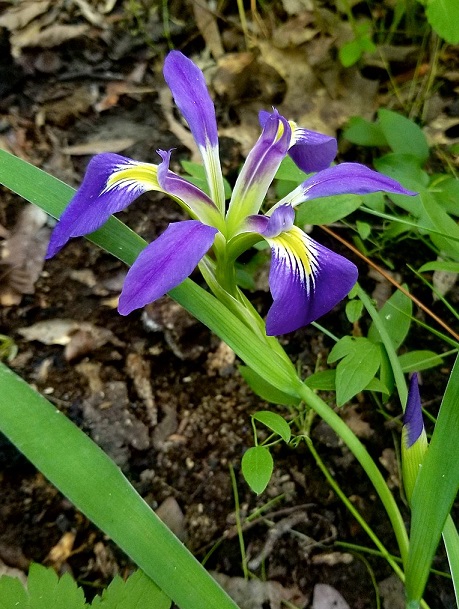
The Leafy Blue Flag is similar in color and shape to the Dwarf Crested Iris.  The primary difference is the height of the stems.  Leafy Blue Flags are often found around old homesteads where they have been transplanted to beautify yards.  The flower is abundant and is supported by a long "zig-zagged" stem with glossy leaves.  The Leafy Blue Flag will produce between three and six flowers per stem.  The plant begins growing early in the Spring and is very tolerant to frost and colder temperatures.
Source: Wikipedia

Dwarf Crested Iris
Iris cristata
April to May
The Dwarf Crested Iris is one of the most prolific early Spring plants.  Its purple and white petals, with a slight yellow tint, can be seen in large pods along the Sheltowee Trace.  The flower is abundant across the United States and much of Canada.  The shallow-rooted plants grow about 6-10 inches tall and are dormant during winter.  The plant is moisture-dependent and prospers in most and somewhat shaded areas.  Whitetail deer enjoy a good snack on the young flowers and leaves of the plant.
Virginia Bluebells
Mertensia virginica
March to May
This delicate and short-bloomed flower can be found along streams and in moist forest floors from March through mid-June.  These blue, purple, and pinkish flowers erupt from the soil while it is still cold and occasionally with snow on the ground.  They bloom in pods at the top of the stalk and help add color to the brown forest floor.  When conditions are right, large colonies of these early bloomers can be seen in the Daniel Boone Forest.  Virginia Bluebells can be found in recessed or shaded places along the trail.


Mayapple
Podophyllum peltatum
April to May
All along the Sheltowee Trace, large fields of Mayapple "trees" can be seen on both sides of the trail.  These tall (about a foot and a half) plant hide their small white flowers under a large canopy formed by the plant's leaves.  The May apple loves exposed areas and can grow in large numbers in open woodland, meadows, and along the forest edge.  The large leaves, resembling an umbrella, are some of the first plants to burst forth from the ground in Spring.  Once pollinated, the small flower turns into a small green fruit eaten by many tortoises who help spread the plant's seeds.  The Mayapple plant is severely toxic to humans if eaten; even minor contact can cause skin irritations.
Solomon's Plume
Maianthemum racemosum
April to May
Solomon's Plum, also known as False Solomon's Seal, is a plant with bright green flowers and produces a cluster of white flowers that extend from the end of the stems.  The flower grows in every state in the Union except Hawaii.  The white flowers are pollinated primarily by bees and butterflies, producing bright red clumps of berries in the Fall.  Solomon's Plume does not grow on mountain peaks above 9,000 feet (not a concern on the Sheltowee except for maybe Thunderstruck Hill).

Source: Wikipedia
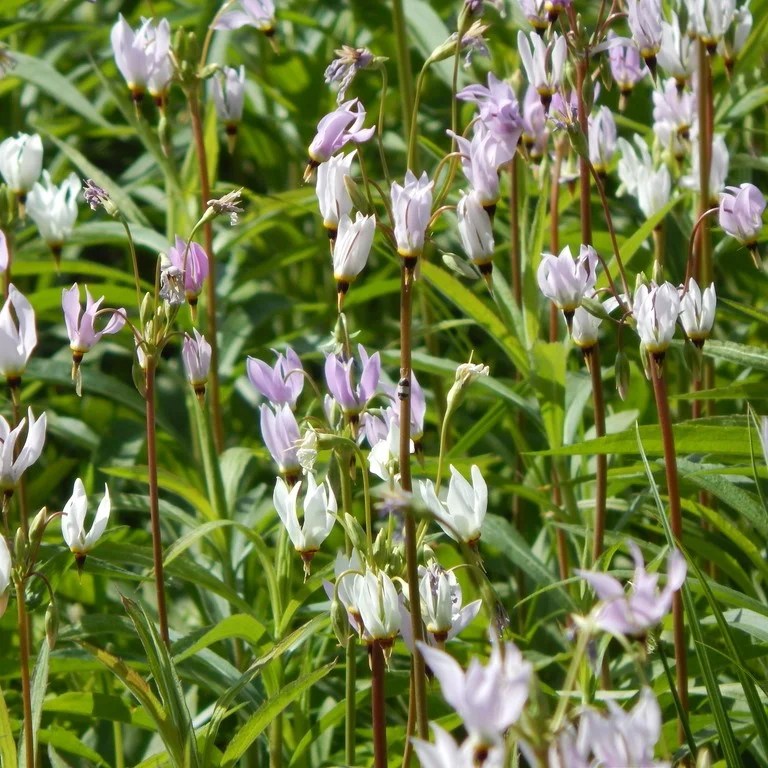
Eastern Shooting Star
Primula meadia
April to May
Very popular with bees in the early Spring, the Eastern Shooting Star was named for its white plumes resembling a shooting star across the sky.  The white petals bloom in moist soil across every geographic region of Kentucky from early April through May.  The Eastern Shooting Star grows better in a slightly shaded area in the forest and open prairies.  Because the flowers are positioned "upside down", bees and other nectar-consuming insects must climb up to gather their reward.
Rue Anemone
Thalictrum thalictroides
April to May
Rue Anemone loves damp leaves and small, moist areas in the hills of Kentucky.  They can also be found in the open fields of Central and Western Kentucky.  The small plant prospers in rich limestone-based soil similar to that found in the Appalachian foothills.  The white blooms of the Rue Anemone grow to a height of about eight inches and will have several blooms on each plant.  The flower's sweet nectar draws butterflies in the early Spring when few food sources are in bloom.  Deer, rodents, and other forest animals often consume the flower's stems and leaves.


Large White Trillium
Trillium grandiflorum
April to June
The White Trillium produces large white flowers and can be seen along the trail in many places.  As we passed Resurgence Cave, many plants and their blooms were already in bloom in April.  The Large White Trillium is one of the favorite meals for white-tail deer.  The significant rise in the deer population has resulted in a decrease in White Trillium.
Toadshade
Trillium sessile
April to May
Found primarily in Central and Eastern Kentucky, the Toadshade is a variety of trillium and can be found in partly shady spots in sandy to medium soil.  The flower blooms on the top of the leaves from April through the end of May.  The plant was named for the texture of its leaves, which many describe as similar to the skin of a toad.  Bees and other forest insects, including ants, help the low-growing flowers disperse their seeds.
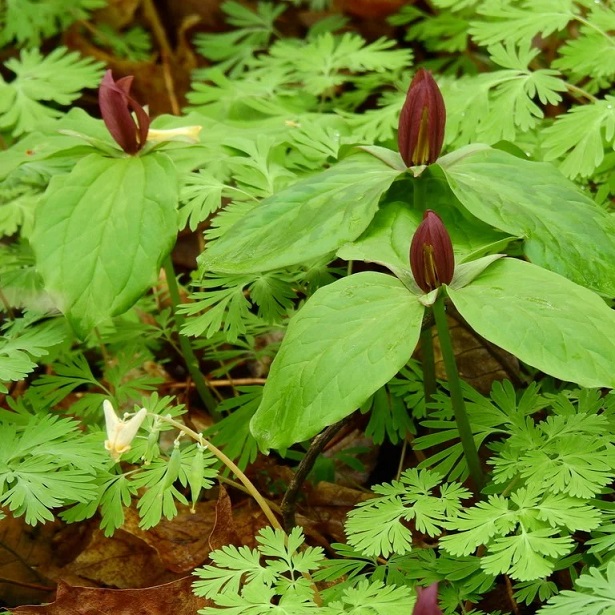
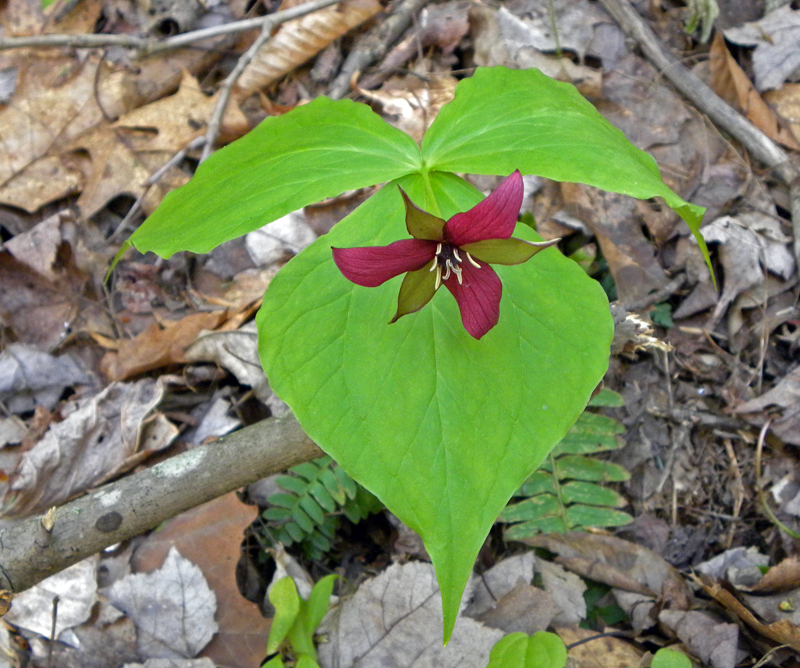
Red Trillium
Trillium erectum
April to May
A cousin and similar to the Large White Trillium, the Red Trillium is more common in the wood that we will traverse.  The plant grows about a foot high and produces a large red flower comprised of six petals.  The bright flower, which can grow nearly three inches in size, is collared by three leaves.  Butterflies and other flying insects are attracted to the nectar of the Trillium and can be found buzzing around these large areas covered with Trillium.
Golden Alexanders
Zizia Aurea
April to May
A member of the carrot family, Golden Alexander grows throughout Kentucky and much of North America. The plant's bright yellow flowers present themselves in a "flat-topped" crown of flowers with five petals and five yellow stamens. They have compound leaves, and the flowers will produce small egg-shaped lobes filled with two seeds each.

These are the most common flowering plants we will encounter during the May Hike. There will be many others as we pass through several diverse biospheres. Pay special attention to the differences between the shape and color of flowering plants along the sandstone cliffs and on the ridges. They will vary widely from plants we found along the creeks and in marshy areas. The natural species that grow along our walkway will prosper if we respect them and their habitat.
Watch where you step and take only fond memories and maybe a few pictures.
Please let me know if you would like to learn more about the flora and fauna we may see during our hikes.
© 2024 Stephen D. Bowling

 Bookie on the Trail