April 8, 2024’s celestial events are not the first seen in the sky, causing Breathtit County residents to look up. Beginning in 1778, at least twenty-three documented events would have passed over Breathitt County and were seen with the weather’s cooperation. In 1869, a total eclipse passed over Jackson and most of Kentucky, causing the temperature to fall 14 degrees while the moon blocked the sun. Other tales from Kentucky’s past solar events dot our history.
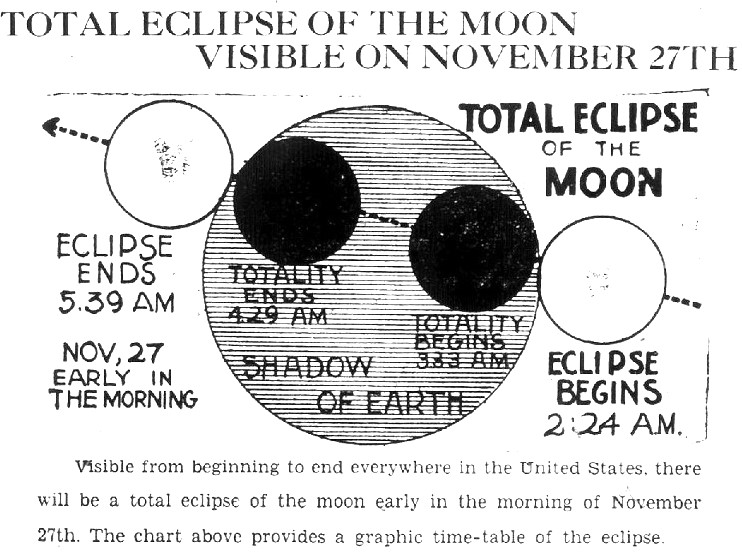
Not all the eclipses in Breathitt County and Kentucky have been of the sun. In November 1928, The Jackson Times and other newspapers across the state published stories detailing the lunar eclipse that would occur on November 27th. Papers nationwide cautioned readers that the event was “natural and predictable” and was not a sign of the end of time. They made numerous efforts to calm the public’s nerves during an event that “many did not understand,” they believed.
For Breathitt County, one solar eclipse provided a greater show than many. Across the country, “Eclipse Mania” grew as news reports informed the public about the “total darkness that was to fall across Kentucky in the middle of the day.” Amateur local astronomy John Sewell wrote an article in The Jackson Times helping to remind Breathitt County residents of the event.
TOTAL ECLIPSE OF THE SUN
The total eclipse of the sun, which occurs next Saturday afternoon, will be visible as a partial eclipse here in Jackson, beginning at 4:36 p, m. and ending at 6:39. At the middle of the eclipse (5:38) ten digits of the solar disc will be eclipsed to us here in Jackson. So, it will be a grand spectacle to view through a piece of smoked glass.
At the same moment, when greatest here, it will be total dark at a point on the Mississippi river, a little below Memphis. Jackson people who wish to view the progress of the eclipse during the two hours and three minutes should climb to pretty high ground, affording a good view to the westward, and watch the southwestern edge of the sun’s disc for the first appearance of the “notch.”
The next appearance of this total eclipse will be visible in the United States, with similar elements, in the year 1936, several years after the total destruction of the German Empire; after they have “beaten their swords into plowshares and their spears into pruning hooks,” and after they have ceased to “learn war anymore.”
Uncle John Sewell.
The Jackson Times, June 7, 1918, page 3
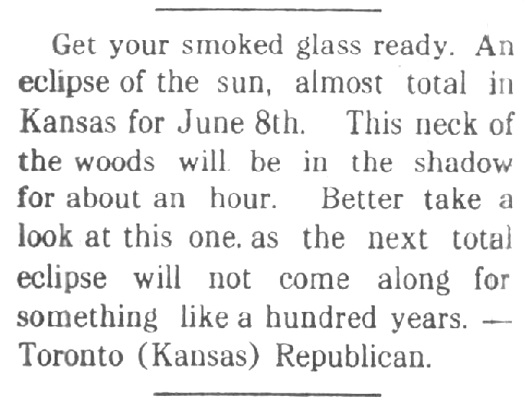
Many in Jackson and around the mountains of Kentucky were interested in seeing this event. In the days before cheap “solar glasses” were in wide distribution, the pinhole method was used, but there was also another way to view the eclipse in 1918. The Jackson Times ran a small clip from the Toronto Republican newspaper in Kansas describing the use of “smoked glass.”

One local observer recorded that the June 8, 1918, eclipse in parts of Kentucky started at about 5:28 in the afternoon and was complete at about 7:29. While the narrow band of total eclipse passed to the south of Jackson, more than 47 minutes of dimmed light were recorded. The same “dimmed darkness” covered much of the states in the southern section of the country. One account stated that chickens “alighted to the trees” as they started to roost, thinking it was nighttime. Little else was said about the event, and life returned to normal across the country as interest faded. Around the world, many took the eclipse as a sign that the terrible bloodshed and tragedy of the World War ended. Hostilities would not take long to cease, but they were not connected to the eclipse.

In a world without social media and the 24-hour news cycle, the eclipse in 1918 was major news for the papers. Modern science and improved calculation can predict the exact moment and path of totality to a great degree. Improvements to cameras and video recording devices (including our phones) will help us document this event better.
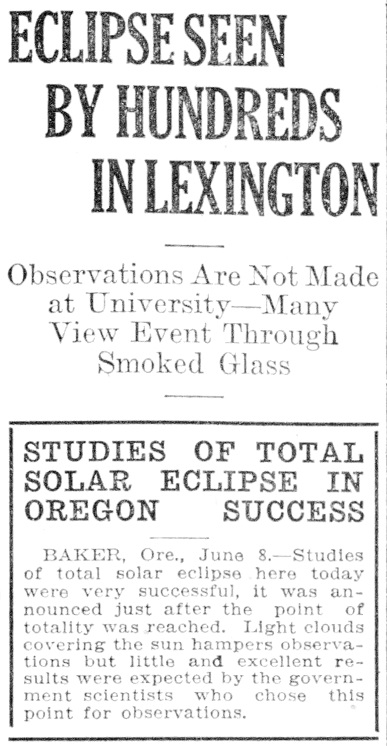
Regardless of the many advancements and changes, one thing will remain the same. When the eclipse occurs in 2024, we will do exactly what the people of Breathitt did in 1918- stand outside and look up at the sky in amazement.
© 2024 Stephen D. Bowling

 Bookie on the Trail