By Stephen D. Bowling
Most people thought he was different. He smiled and was shy but spoke in a direct and empathetic tone. Unlike most politicians, he had been there and seen poverty firsthand in the mountains of Kentucky, in the Mississippi Delta, and on numerous Native-American reservations across the West. He was a man of the people and the last great hope for others. Then one night in California, the dreams and hopes of many evaporated with the squeeze of the trigger of a pistol.
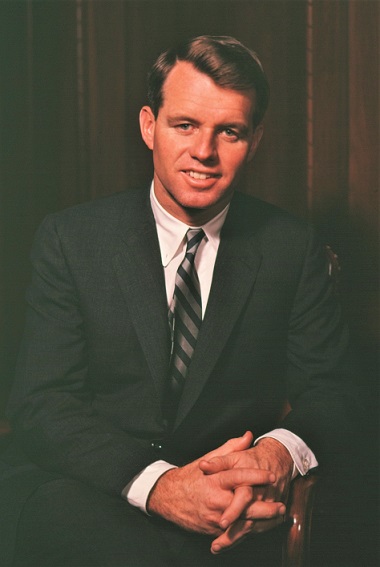
Robert Francis “Bobby” Kennedy, the younger brother of President John F. Kennedy, served as Attorney General for his brother and later under President Lyndon Johnson. Bobby and Johnson did not agree on many issues, but the strain of the Vietnam War widened the divide. Johnson prepared to run for reelection in 1968, and Kennedy was considering a run of his own.
On February 13, 1968, Robert F. Kennedy’s plane landed at the airport in Lexington. The plan was to travel throughout eastern Kentucky and gather testimony and evidence about the effectiveness of the Food Stamp Program and other federal programs. Kennedy, invited to the area by Harry M. Caudill, planned the trip to see the conditions in the mountains and the impact of strip mining on the region. Caudill, a frequently controversial author, had long championed the plight of the people and the environment in the foothills of the Appalachian Mountains. Kennedy’s trip would allow him to personally observe the current state of affairs in one of America’s most remote and poorest areas.
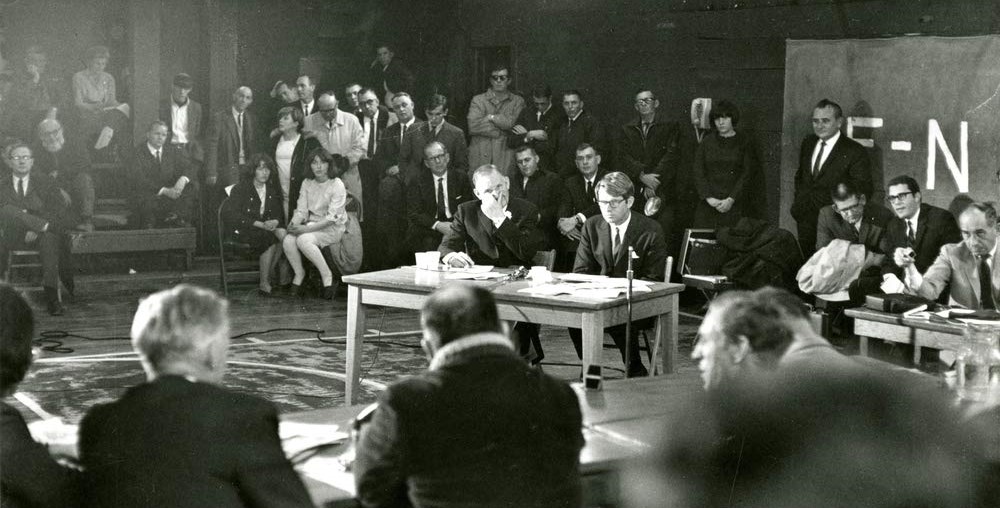
From Lexington, Kennedy, Senator John Sherman Cooper, Congressman Carl D. Perkins, and a long parade of cameramen drove the dusty roadway up into the mountains to their first stop at the Vortex School in Wolfe County. Many observers described the small, one-room school as a “whirl of people, clicks, and flashbulbs.” Kennedy opened a Senate sub-committee hearing at the school and listened to testimony from several witnesses. “Kennedy told the crowd that “it is not acceptable that people are not getting enough to eat” when he talked about the Food Stamp program and the practice of buying stamps.

One of the Vortex witnesses was Swango Fugate from Breathitt County. Fugate was a former miner who lost his job due to mine automation. He traveled from Hayes Branch to tell his story at the invitation of Kennedy. Kennedy stood beside the teacher’s desk with his hand in his pockets as Fugate talked about his family’s difficulties. Fugate told Kennedy and the crowd that his family survived on food stamps but could not afford the $72 dollars per month that he has to pay to receive the stamps. When Fugate concluded his remarks, Kennedy told the crowd, “We will have to do something about that very soon.”

As the national media recorded the testimony for replay on the evening news, Nancy Cole of Barwick walked to the desk and told Kennedy about her plight. “I have five boys, and none has a job in Breathitt County,” she said. “They’ve had to leave. I have three boys now in Chicago.” She talked about the lack of jobs and a steady income after the decline in the coal industry. She told Kennedy what life was like living on government assistance and how difficult it was for a “proud people to accept help.” “We eat really well at the first of the month,” Cole said, “But live on bread, beans, and potatoes the rest.”
John Akeman, a long-time resident of the Barwick community, reiterated the suffering that many in his community experience without jobs and a steady source of income. He talked about how he and his neighbors survived. Kennedy thanked Akemon for his honesty and told those gathered that “these are the true stories that America needs to hear.” “The Welfare Program is not the answer to our problems,” he told the crowd as he closed the first hearing. “We have got to do away with welfare.” Kennedy and the entourage loaded the cars and drove on into Breathitt County.
Breathitt County residents gathered at LBJ School anticipating a “surprise stop” to see the new school. Many more gathered along Main Street, as many visiting politicians stopped to make a few impromptu remarks while standing on the steps of the Courthouse. They were shocked as the long line of cars drove past the turn to Jackson and traveled south on Highway 15. When asked why he did not stop, Kennedy later told one Breathitt Countian that he was “here on business.”
He wanted to see the places described by John Akeman and Nancy Cole. After entering Perry County, his driver made a right turn off Highway 15 at Grapevine, and they drove the curvy road over the mountains to the small railroad community of Barwick. He arrived to applause from the students at the tiny Barwick School. Kennedy was greeted by residents of the community as he made some remarks and then looked around the area before loading the cars and heading off to Hazard.
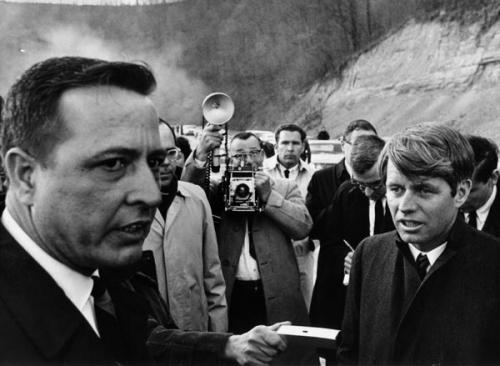
After leaving Barwick, he traveled to an urban-renewal site on Liberty Street in Hazard, attempted to visit a working strip mine in Knott County, and stopped at the Courthouse in Whitesburg before going to Fleming-Neon School for another hearing.
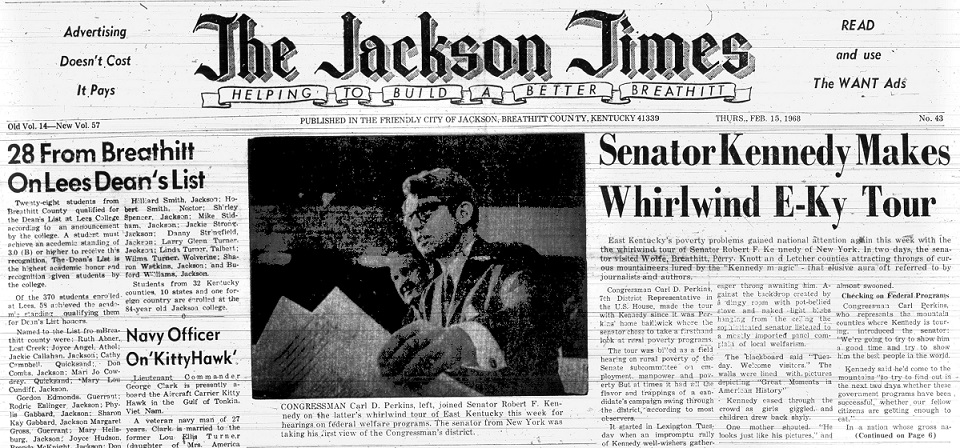
The Jackson Times noted his brief visit to the county but did not give a glowing review in its February 15, 1968 edition. The Times provided few details of the Senator’s time at Barwick and only briefly outline the testimony of the Breathitt County witnesses primarily due to the Senator’s snub of the county seat. “At every stop,” The Times printed in the continuation of the story to page 6. “Senator Kennedy reiterated that ‘welfare must be stopped.’ So…Who’s arguing.”
Kennedy returned to Washington “more determined that we can do better,” one political aid said. On March 16, one month after his visit to Kentucky, Kennedy announced that he would run for President against Lyndon Johnson in 1968. His campaign was slow to start, but Kennedy was gaining momentum, and most believed was the presumptive Democratic candidate. All that ended in California on June 6.
A little over three months after his whirlwind visit to Breathitt County, Robert Francis Kennedy was dead. He was shot only moments after winning the all-important California Democratic Primary on June 5. The assassin, Sirhan Bishara Sirhan, emptied his .22 caliber LR Iver-Johnson Cadet Revolver at Kennedy, hitting him three times as he exited through the kitchen of the Ambassador Hotel in Los Angeles. An ambulance rushed Kennedy to the nearby hospital, but he died a few hours later at 1:44 a.m. on June 6, 1968.
The Jackson Times sounded a more respectful tone in its June 6, 1968 paper when it printed the headline: Our Most Shameful Hour and turned the assassination toward the political goal of passing gun legislation then being considered in Washington.
Our Most Shameful Hour
“We pray that divisiveness and violence be driven from the hearts of men everywhere”
Called upon for the second time in less then five years to lead the nation in mourning the victim of an assassin’s bullet, President Lyndon B. Johnson spoke the above words from the White House yesterday, June 5, in a prayer for the life of Senator Robert Kennedy who lay gravely ill in Los Angeles’ Good Samaritan Hospital following brain surgery for gunshot wounds received just after midnight.
Shot at his campaign headquarters in the Ambassador Hotel at 12:30 a.m. Pacific Daylight Time during a moment of triumph, the celebration of his stunning victory in the California Presidential primary, the brother to the late President John F. Kennedy lived another 24 hours after tragedy struck.
Senator Kennedy died today, June 6 at 1:44 a.m. PDT, an even blacker and more shameful day in American history than when Lee Harvey Oswald shot down the President that bleak day of November 1963. More shameful because we in America have learned nothing apparently from the tragedy which befell us four and a half years ago. Still we fight, riot in our city streets. . . laying waste our own properties and we let our leaders be shot down like dogs. Dallas taught us nothing . . . will California do no more?
We stand shocked and saddened once more by the news that, a second brother of the Kennedy clan has fallen to an assassin’s bullet. “Something must be done!” we declare in our clusters of shame and grief. But what?
The most immediate thing, outside of offering our prayers for this slain man’s family and our country, is to urge Congress to pass the long-sought legislation to restrict the sale of firearms. It is necessary if we are to prevent guns from falling into the hands of irresponsible persons . . . who would go about committing more murders when least expected.
This newspaper urges you to write our Senators and Representatives- Senators Cooper and Morton and Congressman Perkins, to help pass this bill immediately. We didn’t learn in Dallas. We MUST learn in California if our nation is to survive.
Of course, this bill alone will be little panacea for the many ills besetting America. We as individuals must recognize our responsibility as citizens of the greatest nation on earth and realize again that we are privileged indeed to enjoy its benefits.
We must concentrate less on “rights” of majorities or minorities and remember that foremost we, all of us, have “responsibilities” as citizens. This newspaper, a little one in the heart of the Appalachian Region which benefited greatly from the Presidency of the first fallen Kennedy, extends its sympathies to Senator Robert Kennedy’s widow, Mrs. Ethel Kennedy, and their 10 children and all the Kennedys in this time of great sorrow. We would urge our readers to be much in prayer during these black days and follow President Johnson’s request to observe Sunday, June 9, as a National Day of Prayer.”
America never needed it more.
The Jackson Times, June 6, 1968, page 1
Robert Francis Kennedy was buried near his brother at the Arlington National Cemetery in Washington, D.C. His last few months were filled with the excitement of another political race and a visit to the mountains of Kentucky, where he saw, experienced, and hopefully understood a small sample of the misery that existed (and still exists) in the many corners of what he called “the other America.” Kennedy believed that he and the richest nation in the world had an obligation to help. The hopes of many of the “poor and forgotten people” he often spoke of died with him that June night.
His brother, Edward “Teddy” Kennedy, summed RFK’s belief that we can do better when he eulogized him at his funeral by repeating one of Bobby’s favorite sayings, “Some men see things as they are and say why. I dream things that never were and say why not?”
Service must begin in our hearts with a simple love that moves our hands and feet to help others.
For more information and more pictures, visit the Robert F. Kennedy Performance Project.
© 2023 Stephen D. Bowling

 Bookie on the Trail