
By Stephen D. Bowling
It was a bloodbath.
What had been touted as a real test for both teams ended in one of the most lopsided football games in the sport’s history. Unfortunately, the Lee’s College Bearcats were on the losing side.
Founded in 1887 by Methodist Minister John J. Dickey, Lees Collegiate Institute, later Lees Junior College, was the only college in the south-central portion of the Cumberland foothills. Situated on the hill overlooking Jackson, the school educated a generation of teachers, lawyers, doctors, and other community servants. Dr. Dickey left the school, and several successive Presidents worked to keep the school open and to bring more interest to the campus, including sports.
Hopes were high in August 1927 when Lees College President Donald Wilson Miller announced plans to introduce football as a sport at the small college. “Lees College is launching a campaign during the coming week which will enable the institution to put on a football team of the highest order,” Miller told The Lexington Herald on August 21. “There are no colleges or universities of any importance that neglect intercollegiate football, basketball, and baseball.”
Miller told the press that “when properly supervised and guided,” sports can make a distinct difference and enhance the educational process. He was proud of tennis, volleyball, hockey, and other sports already being played at the college.
“After considerable thought on the matter,” Miller said, “the advantages to be gained from the playing of football by colleges far outweigh possible disadvantages.” “A winning football team at Lees this fall is bound to put Jackson on the map,” he added.
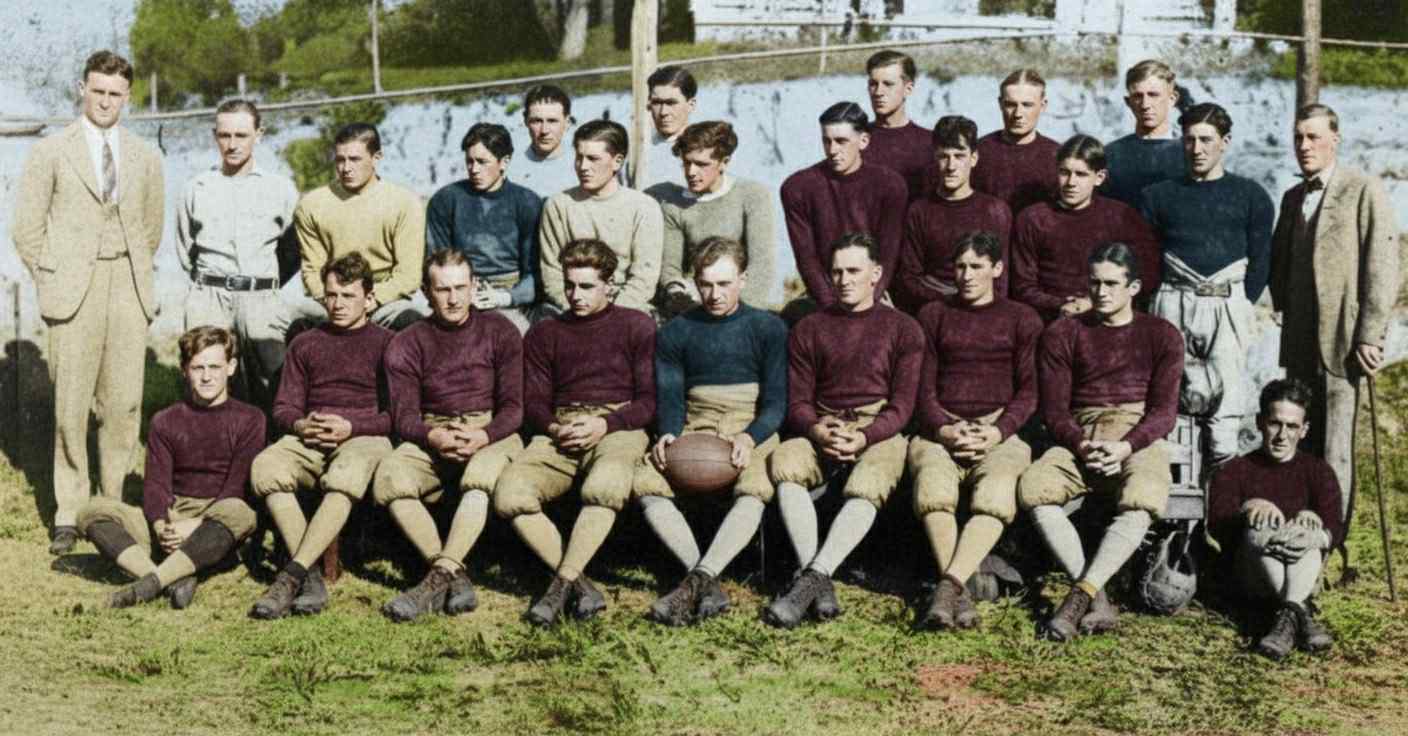
Miller hired J. Carlisle Spencer to coach the new team and ordered a few books to help him learn and understand the rules. No one in Jackson had experience playing the sport, although several offered their help, having watched games in Lexington.
Harold Holliday signed on as manager and went to work contacting other schools and working on a schedule. With no other colleges with teams nearby, several local high schools in neighboring counties agreed to play the new team. Holliday did manage to arrange games at home and away with Witherspoon College at Buckhorn, Hazard High School, Hazard College, and Jackson High School.
How Lees added St. Xavier University to their schedule is debated. One version of the story indicates that a traveling sporting goods salesman selling tennis rackets and balls to the college learned they were planning a football team in the Fall of 1927. He suggested they contact his alma mater and schedule a game with Xavier, which Holliday did.
The second version, told in Jackson, resulted from a visit to a uniform manufacturer in Cincinnati by Joe Meyer, the coach at Xavier University. His team was expected to be very good in 1927, and he also wanted them to look good. He traveled to the uniform company to order new jerseys when he noticed several new ones coming off the sewing table. “Who is that?” Meyer asked. “Some small school in Kentucky,” he was told. The story was told that Meyer contacted the school and set up the game.
Both schools agreed, and the kickoff was set for Saturday, October 15, 1927, at Corcoran Field, Xavier’s home turf in Cincinnati, because Lees did not have a regulation field.

Lees did not have any buses either. Players and their families piled into several cars before daylight on Saturday morning and made the long trip “up north” to take on the St. Xavier Musketeers. Several rode in the back of a cattle truck with a heavy canvas draped over the wooden rails.
Many former Breathitt County and eastern Kentucky residents paid the $1.00 admission to watch the hometown boys take on the “Meyer’s Goliath squad.”

The newspaper had highlighted and promoted the clash for the week leading up to the showdown.
Xavier Coach Joe Meyer said he was “guarding against overconfidence” after his team celebrated three lopsided victories to start the 1927 season. His squad defeated Transylvania 39-0 two weeks before the scheduled match with the Bearcats.
The players were feted as conquering heroes when they returned from a victory over Western Reserve at Cleveland the previous Saturday.
The campus and the students were excited for the next match as the newspaper described the Musketeers as “the strongest team ever to represent Xavier.” Lees would be their last match before a long and grueling run of six games, including a looming contest with Oglethorpe College, which was reported to be the strongest team in the country.
The stage was set. Xavier and their quarterback, Tom Clines, welcomed the small team from Lees to Corcoran Field with a mix of graciousness and confidence. On the opposing sideline, Xavier had more than 100 players fully decked out in new pads, helmets, and uniforms.
The Bearcats, numbering twenty-two in all, sported used or “hand-me-down” equipment donated to the school, but proudly wore their new jerseys.
On paper, many believed that the scrappy Lees team would play Xavier close. The consensus around Cincinnati was that the “corn-fed” boys from the mountains of Kentucky would be big and tough. A Kentucky Post headline in the Friday, October 14 edition predicted that “Lee’s Huskies Should Test St. Xavier Team.”
The results were just the opposite.
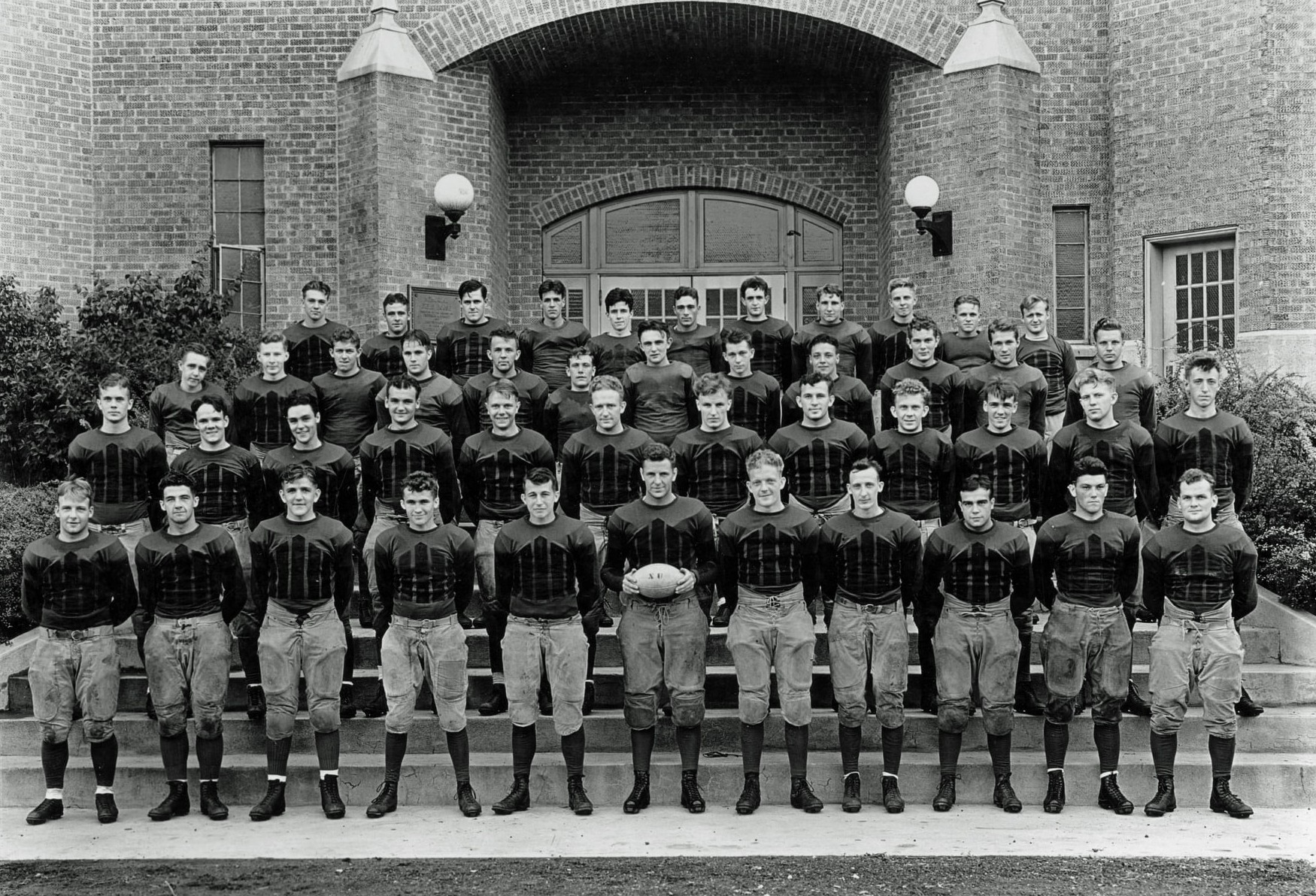
A reporter from The Lexington Leader said the game was a “study in mathematical calculation.” Xavier broke their squad into four teams and constantly ran them onto and off the field, while the tired, bruised, and weary Lees team barely had enough players for an occasional replacement. Coach Spencer barely had time to allow his players to get a drink of water before he ran them back into the slaughter.
The Leader reported that the fourth team started the game and played the first quarter, shutting out the Bearcats 31-0. The third team managed only thirteen points against Lees in the second quarter while holding the team from Jackson scoreless. Half-time was a much-welcomed break, but the onslaught continued in the third quarter.
Coach Clines put his second team in for the third quarter, and they racked up thirty-seven points, and their defense allowed no first down to the Lees squad. The fourth quarter was no better; again, the St. Xavier defense was unwavering and completed the domination of the Bearcat offense, holding them scoreless and only allowing one first down. One reporter believed the first down in the fourth quarter was an “act of graciousness.” The Musketeer offense tacked on another fifty-one points in the fourth quarter to end the game 132 to 0.
A Lexington reporter said that the Musketeers “threw the ball over, under, and around the Kentuckians.” The observer reported that “each play was a race for the goal line with all 22 men, except those lying on the ground, and the referee.”

The Bearcats were simply overwhelmed. One former team member said we were “distracted” by the big city and all its attractions. Several of the Bearcats had never been to the “Big City” and were amazed by what they saw. At one point, the game was delayed while several Lees players stood up and stared as a low-flying plane passed overhead. Hardly two minutes into the game, the game was, for all practical purposes, already over.
Xavier’s high-powered offense layered on the points. In their first three games of the year, they outscored their opponents 131-13. Against the Bearcats, the team eclipsed that total by one point, scoring 132 points. Halfback Frank O’Bryan tallied six touchdowns and two runs for an extra point that afternoon. Xavier’s Eddy Burns chipped in five scores for good measure.
As Miller had predicted, the game put Lees College and football in Jackson on the map, but not in the way he intended.
The long ride back to Jackson over the curvy hill of Highway 15 was solemn. The pain of defeat faded with time, but members of the team rarely talked about their day in Cincinnati. The Hazard Herald mocked the Bearcats in its October 18 edition, saying they had “predicted a sound trouncing for the Breathitt boys as they were entirely out of their class.”
Earl Goff, a 1927 Lees Bearcat team member, described the defeat as a “most colorful skeleton” in the closet of Lee College sports. Goff painfully recalled the thrashing the Bearcats experienced and how they had been the laughing stock of college sports that fall.
He laughed many years later as he told a Jackson Times reporter, “The story might be amusing to somebody, but it still hurts me to think about it.”
Football at Lees College only continued for a few more years. The program recovered from the loss and in 1930, claimed the Kentucky State Junior College Championship by defeating Sue Bennett in a rainy showdown played in ankle-deep mud.


Following their game, St. Xavier University went on to record an 8-1-1 record under coach Joe Meyer. He would amass a 94-52 record at Xavier. He resigned as a coach in 1935 following a disagreement with the Xavier administration. He would become the head coach of the University of Cincinnati from 1938-1942. He died at the age of 75 in 1970 and is buried in Hamilton County, Ohio.
The score, 132-0, stood for many years as the worst loss in American college football history. That record was wiped away when it was learned that a game played in 1916 between Cumberland College and Georgia Tech resulted in a Yellow Jacket victory by 222-0.
For the players on that 1927 Lees Bearcat team, adding the Cumberland College loss to the record books, displacing the Lees defeat from the top of the list, helped some, but it never completely removed the pain of that fateful day in October 1927.

© 2025 Stephen D. Bowling

 Bookie on the Trail