Ross Smith sat beside the door of his small cabin on Frozen Mountain, whittling on an axe handle. A reporter from The St. Louis Post-Dispatch pulled his car off the roadway and parked just a few feet from the front door. Ross Smith continued to whittle as he sat by the open door to the small home he and the boy shared. Little did Smith know that the impromptu visit would bring good fortune to their lives.
The Mystery Boy of Frozen
F. A. Behymer came to Jackson looking for a good human interest story for the paper to run during the holiday season in 1950. While eating at a restaurant in Jackson, someone told him about the small cabin and the unusual story he would find there. Behymer finished his meal and headed up the winding slopes of Frozen Mountian. He saw the quaint cabin and stopped looking for Ross Smith and Breathitt’s “Mystery Boy.”
The “big city” reporter stepped out of the car and introduced himself. He explained that he had been told about their situation and wanted to help by writing a newspaper article about the boy without a name that Smith and his mother had taken in as their own. Ross Smith initially was not interested, but after some time, he relented and told his story to the reporter. And what a story it was that all started at the Bloody Bucket on Quicksand Road.
In the winter of 1944, Ross Smith and his mother, Sallie Lunceford, were at their home on Quicksand Road when a car parked in front of their house. Two couples got out of the car and ran across the road through the cold night air to the loud music and party sounds that came from the Bloody Bucket. Inebriated drivers often parked in Sallie Lunceford’s yard and went to the well-known roadhouse, which earned its moniker because of the frequent violence. But this time, something was different.
After some time, Sallie Lunceford heard the faint sounds of a baby crying in the parked car. She walked out to the car and looked in to see a baby lying in the back seat. She opened the door and got the cold and hungry baby out of the car. As she stood beside the roadway and tried to warm the baby, the four revelers came back across the roadway. One witness said that Lunceford “lit into them.” She berated them for their lack of compassion and continued until they climbed into the car. She told one of the women that they did not deserve a child. “Give that baby to me so I can take care of it,” she said.
Without hesitation, the woman said, “All right, take it.” The occupants of the car had a good laugh and drove away.
Lunceford took the child inside and sat by the fireplace with it until the baby warmed up and stopped crying. She removed its clothing and learned the child was a boy, who, she estimated, was 7-8 months old. After checking, she realized that the child was “near starvation and had not been bathed in some time.” Sallie Lunceford soon changed all that. A warm bath and small meals helped nurse the baby back to health before it was able to eat regular portions. Compassion and love saved the young boy’s life. But she had not asked his name before the car drove away.
She expected that someday, the mother would return. She never did.
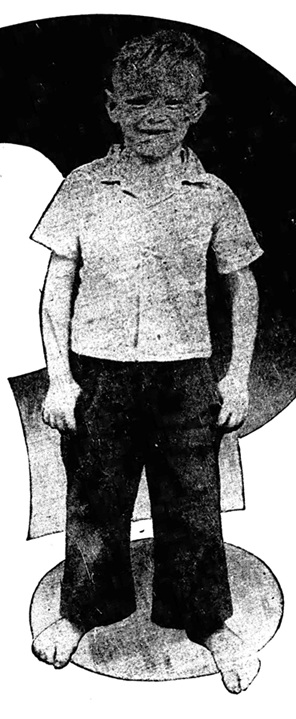
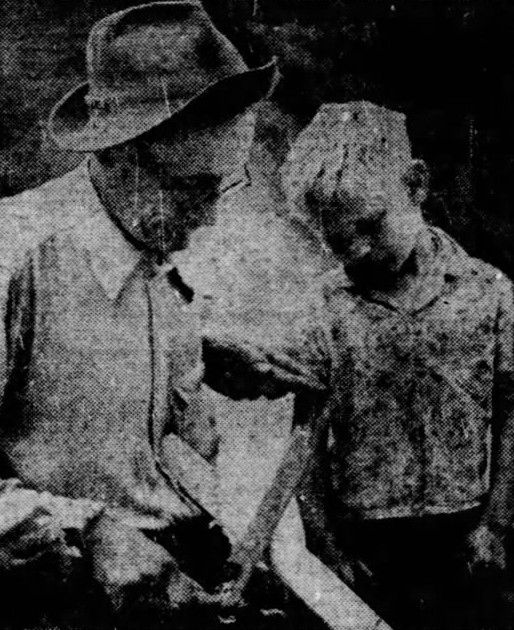
Ross Smith and Charles Ray Smith in November 1950.
For the next three years, Sallie Lunceford cared for the baby and her disabled son, Ross. She named the baby Charles Ray Lunceford. Sarah “Sallie” Lunceford, 63, suffered a possible heart attack near the end of February 1948. She was bed-stricken and unable to care for the child. She called Ross to her bedside and said, “Promise me that you will take care of the baby as long as you live.” He agreed.
For Ross Smith, this agreement was an easy choice. He told the St. Louis Post-Dispatch that he loved the boy “more “better’n anything on Earth.” Supporting him would be more difficult. Ross Smith identified himself as a “fifty-year-old cripple” after his foot was mangled in an accident about 1938. His only real source of income was the meager cash he made from selling his “whittlings” on the roadside to tourists who passed by their home. Regardless of the challenge ahead, he agreed.
Sallie Lunceford died of heart complications on March 3, 1948, and was buried near her home then at Wolverine. Ross took charge of the boy and changed his name to Charles Ray Smith. Smith and the boy moved from place to place for some time and finally settled on a small patch of ground on the side of Frozen Hill. The six-year-old Charles Ray Smith enrolled at the Strong’s Fork School and excelled.
His enrollment without a birth certificate or any other information, including a birthdate, sparked the interest of the local child welfare agencies. They soon paid Ross and Charles Ray a visit at the small home. A defiant Ross Smith told the “nice ladies from the county” that he was not on “relief” and did not want it. He told them he was keeping the boy “with or without papers” and did not need their help.
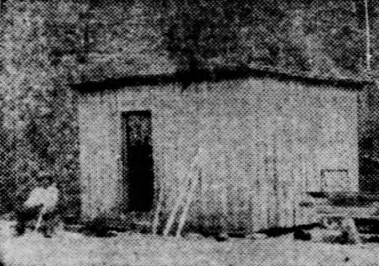
Ross Smith sitting outside the small cabin in Frozen Hill.
“They needn’t to come around here talking about putting him in the orphan home,” Smith said. “No, as long as I live, I’m going to keep him.” Smith told the reporter in 1950 that he had two years left to keep Charles Ray Smith before he could legally adopt him, and that is what he planned to do.
F. A. Behymer returned to Jackson and wrote his story about the “Mystery Boy” of Jackson. He sent it to the newspaper in St. Louis. The nearly full-page story ran on the front of The Everyday Magazine section of the November 19, 1950 edition of The St. Louis Post Dispatch. The response was immediate. Calls and letters poured into the newspaper office, and Behymer was flooded with questions about how they could help.
Letters and boxes soon arrived at the little Keck Post Office on Frozen Creek. Behymer wrote a follow-up story, which the Post-Dispatch published on December 31 after all of the Christmas gifts were delivered by Santa Claus.
How Santa Visited “Mystery Boy”
Kentucky Lad Showered With Gifts After Publication of His Story in Post-Dispatch
KECK, Ky., Dec. 30. Santa Claus came to Frozen Mountain. He wasn’t expected because he almost never passes this way. Least of all, was he expected at the cabin of Ross Smith, the crippled whittler, where the mystery boy of Frozen Mountain lives. The mystery boy was maybe 6 years old, but nobody knew for sure because out of nowhere he had come, an abandoned waif without a name of his own, only the one, Charles Ray Smith, that had been given him.
Charles Ray Smith with one of the many gifts he received from strangers for Christimas in 1950.
The boy had heard about Santa Claus and had asked about him. Ross Smith, not too skilled in answering a child’s questions, had said Santa was a jolly old feller who brought gifts to children at Christmas time, providing he got a little help from the grownups. Come winter, though a man couldn’t do much whittlin’ at the cabin door, no more’n enough for grub and coal, so Santa Claus couldn’t be expected to come to where he said, and the boy said yes, he could see how it was.
But Santa Claus came, his pack filled with gifts for Charles Ray Smith. Big cartons came, packed with play-things and candy, warm clothing, boots and shoes, and just about everything that Charles Ray never expected to have.
It is according to the tellin’ that Santa Claus comes only once, on the night before Christmas, but for two weeks and more, he kept on sending gifts through the little Keck post office until the cabin was filled just about to the top.
It was something that the poor folks on the mountain slope and up and down Frozen Creek couldn’t understand. Charles Ray prayed for it, but other children prayed, and nothing happened. It was something that couldn’t happen, but it had. They called it a miracle.
It was not a miracle. At the approach of Christmas, the story of the mystery boy of Frozen Mountain was told in The Post-Dispatch and had been read by men and women who cared. In accordance with Yuletide lore, they had mentioned it to Santa Claus, telling him he mustn’t miss Frozen Mountain this Christmas. He, according to the report, had said he surely wouldn’t. He would make a special stop at Ross make a special stop at Ross Smith’s cabin. Not taking any chances, the men and women whose hearts had been touched appointed themselves Santa’s assistants and started sending packages. That was why Ross Smith’s cabin was stacked with hundreds of gifts on Christmas morning.
Ross first knew about it when Mrs. Mollie Joseph sent word from the post office, a mile down the creek, that there were packages and letters and he should come and get them.
He couldn’t go that day because the ground was covered with 16 inches of snow, and the road was blocked. The man and boy were snowed in, and there was no telling when they could get out. The boy had learned from Joe Riley, the mountain preacher, that when a body is hemmed in and there’s no way out, the thing to do is call on the Lord for help. So, Charles Ray prayed: “Lord, what’ll we do? You gotta come help us.”
After a long time, Smith can’t tell how long, the big snow plow (driven by Harlan Banks) came over the mountain, swinging around the hairpin turns, whirling the snow left and right behind the plow came an automobile with Fred Stidham, Beech Strong and Warley Hickey in it. They hailed, and Smith and the boy stuck their heads out at the door. “We been scared to death about you,” one of them shouted, “afraid we’d find you froze to death. We’d never got here if it hadn’t been for the grader. Got any grub?”
“Ain’t got much,” said Smith.
“Any coal?”
“Just a few chunks left.”
They lugged in some grub, Smith relates, and told him Charlie Davis, the coal mine man, was going to send him a ton of coal as soon as a truck could get through. “We was about out of everything,” says Smith, “and headed for freezin’ when they come along.” They took Smith down to the post office and Mollie Joseph handed him out eight letters and a few parcels. One registered letter contained $10.
Davis and others knocked on the door of the Smith cabin on Frozen Hill.
There were dollar bills in some of the others. That was the beginning. Letters and parcels kept coming right up to Christmas Eve, when nine heavy parcels arrived, and there was a likelihood that delayed shipments would arrive for several days.
Just a few packages were opened because Charles Ray couldn’t wait, but most cartons were piled on the floor, nearly filling the 8 x 12 cabin to be opened on Christmas Eve. Then, with Rufe Hays and his folks, the nearest neighbors, assisting, there was a great to-do as the gifts, enough for a hundred children, were taken out and inspected and piled on the bed or replaced in the containers because there was no other place for them.
The chief joy and pride of Charles Ray were the red boots sent by Mrs. E. R. Browm of 2423 Walton Road, St. Louis County, who had written to the boy and asked him what he wanted most. Along with the boots had come two pairs of heavy jeans, a warm cap with ear flaps, a plaid shirt in red and blue, and red gloves, a metal drive-in gasoline station, and a plastic train with extra tracks. And to the Red Cross at Jackson, the county seat, went a letter telling them to fit Ross Smith with a pair of shoes and send her the bill. No wonder that later, Mrs. Brown, in a letter to The Post-Dispatch, said that “Christmas day, for a long time, has never been so happy as it was this year.”
There was a wagon that came folded in a carton, sent by W. A. McDonnell of 1531 Switzer Avenue, St. Louis, that was not to be opened until Christmas, but Charles Ray, hardly able to endure the waiting and without any women folks to say no, no, tore off a corner of the container to get a peek at it.
Among the many who had read about the mystery boy of Frozen Mountain were the employees of the long-distance telephone exchange at 2654 Locust Street. Under the leadership of Mrs. Bessie Hauser, contributions were collected, and a carton packed with, among other things, a reefer coat, a plaid jacket, three sweaters, a plaid shirt, slacks, overalls, a dozen pairs of socks, a Lone Ranger gun, three pounds of candy, Crayolas, picture books and comics, money for a pair of shoes, and a can of tobacco for Ross Smith’s pipe. Charles shared the candy with schoolmates he met on the road.
The biggest box, too heavy for Smith to lift by himself, containing 12 parcels, apparently from members of a group, was identified only as from 826 Olive Street. In an accompanying letter from “your St. Louis friends at 826 Olive Street,” someone wrote: “I cannot tell you how much you and Charles Ray have added to our Christmas happiness this year.”
So, it went as the boxes were opened on Christmas Eve, revealing a quantity of goods and articles sufficient to stock a store, “no amount” of clothes, as Ross Smith appraised the supply, meaning a great amount. One pair of shoes was too large for Charles Ray, but Smith said he would save them “till baby grows up to ’em.” The retail cost of the merchandise probably exceeded $500.
Mr. Fidley of 2911 Washington Avenue wrote a letter to Charles Ray, inclosing $6. That, he wrote, was to pay Uncle Ross for the trouble of making him an ax handle, and if he and Smith ever came to St. Louis, he would take them out to lunch. Smith was doubtful about ever being able to accept the luncheon invitation, but instead of an ax handle, he would make him a cane as soon as the weather fairs up so that he could get out into the woods and get the right kind of a hickory sapling.
“It’l work it down nice,” he said, “and boil one end in a kettle of hot water and bend it around a round pole. Then I’ll sandpaper and shellac it, and it’ll be the purtiest thing you ever saw.”
Somebody came by in a car from St. Louis and fitted Smith out with a suit and overcoat, underwear, shoes and socks. Somebody else sent him a dozen cigars. ‘‘Hit’s a long spell since I smoked a good seegar,” he said, “and I make it last about all day, smokin’ it slow. I smoked one yistid dy and one the day before.”
Ross Smith and Charles Ray Smith look through some of the packages they received.
When some of the packages were opened before Christmas, Smith says, “the boy didn’t know how to act. You see, he wasn’t used to having anything. He held every single thing up to his face and loved it and said God bless it. He was tickled so good he couldn’t sleep that night.”
Every day, letters came, at first by the dozen and at the last by the score. Most of them were from St. Louis, and Missouri, and Illinois, but some were from other states. All of them were filled with friendliness and good wishes, and concern for the future of the boy.
It is Ross Smith’s sorrow that he can’t read the many letters that have come to him.
He has two helpers, however. He calls them his secretaries. They are Mrs. Joseph, who is not only the postmaster but Charles Ray’s school teacher, and Mrs. Hays. They read the letters to him and answer the ones that require to be answered. Smith regrets that he cannot answer all of them.
“Just put it in the paper,” he said, “that I thank them for the letters and gifts and how well tickled Charles Ray is. They ought to see him rearin’ back and struttin’ in the fine clothes they sent him. He thinks a heap of all of it, especially the sailor suit that somebody sent him.”
Assurance can be given to the senders of gifts that everyone that reached the tiny post office of Keck was delivered into the hands of Ross Smith as soon as he could get somebody to haul the packages up to his cabin. Mollie Joseph took pride in handling the parcels that came in every morning on the bus. Along with presents came an inquiry from Mrs. Anna Mary Thompson of Dayton, Ohio, who held a faint hope that the mystery boy might be her baby, Ronald, who was stolen in 1944, but it was found that the boy did not fit the description of her child and her hope was destroyed.
Several wrote to Smith asking for the boy. One was a woman in East St. Louis who suggested that Smith bring the boy to her and promised she would help Smith find a job in East St. Louis.
“He is the only child,” she wrote, “I have ever wanted besides my own, and I have raised three.” Smith, however, has no intention of giving the boy away.
He has previously refused several offers of adoption. Circuit Judge Irvin Turner and lawyers at Jackson have assured him that nobody can take the boy from him.
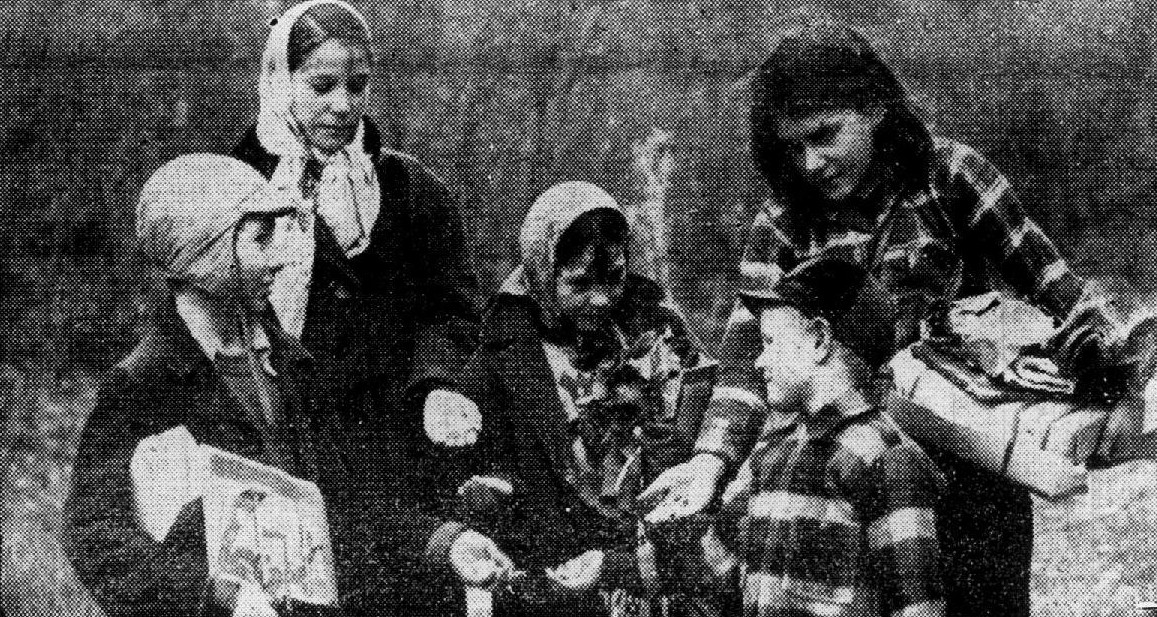
Charles R. Smith sharing gifts and candy with neighbors John Riley, Lois Riley, Dorothy Riley, and Recie Hays.
The most that Smith is willing to do is to share him with Rufe Hays and his wife, who live close by. Their 11-year-old daughter, Recie, is his special play mate, and watches over him with a fierce possessiveness, taking him to Strong Fork school, two miles away, and bringing him home. The boy has found with these neighbors the family life that Smith can but poorly supply and stays there much of the time. Mrs. Hays finds happiness in caring for him, for she has no little boy of her own. He loves her and calls her Mommy and minds her better than he does Ross.
It was to the Hays’s home that the boy went on Christmas Eve after he had examined his gifts. Rufe and Ross brought in a Christmas tree “as high as the loft” from the mountainside, and it was decorated with ornaments that had been sent to Charles Ray.
There were no lights, of course, but in the glow from the fireplace the boy stood in front of the tree with Recie and her older sister, Lillie Marie, as they sang in childish voices, “Silent Night.”
It makes Smith glad that Charles Ray wants to share some of his gifts with other children. It was the boy’s idea to take some of his candy to school for the Christmas tree because, as Ross says, plenty of the other children are as poor as him. Lots of youngins in these mountains ain’t got nothin’. He wanted them to have a bite of his candy.”
Charles Ray was something of a hero at the school Christmas tree, for it had been “narrated ’round” that he had a special stand-in with Santa Claus. As his contribution to the program, he spoke a piece, “A Talk with Santa,” which strengthened the impression that he was on speaking terms with the kind old gentleman.
Further proof was the red boots that had come before Christmas, which he wore for the occasion.
It isn’t exactly a romance, and Charles Ray isn’t going back on Recie, but there’s another little girl in his life. Her name is Tresa, and she is a granddaughter of Mrs. Joseph. He went to see her on Christmas Day and gave her a yarn “hoggin” and gloves to keep her warm, and some candy, too.
All day Christmas, there was a stream of visitors to Ross Smith’s cabin, people coming down from the mountain and up from the creek to see this thing that had come to pass, this miracle as some of them called it. They came and looked and wondered. They did not seem to be covetous or envious. This was something that didn’t concern them except as onlookers. It was just something that happened to Ross Smith and Charles Ray Smith. They were thankful to have a part in it by coming and looking.
The St. Louis Post-Dispatch, December 31, 1950, Section 5, Page 2
What happened after the 1950 Christmas is not easily discoverable. Ross Smith kept the boy and continued whittling axe and hoe handles to earn money. She sold his artistic creation at his little roadside shack when tourists stopped by to look at the items he had on display. Charles Ray Smith was enrolled at Jackson City School for some time, and then the trail goes cold.
Ross Smith’s health declined over the years. He was admitted to the Nim Henson Nursing Home in 1972. He died on March 26, 1973, at the Hazard Appalachian Regional Hospital in Hazard. He was 86. He was buried in the McIntosh Cemetery on Frozen Mountain, near the small cabin he had Charles Ray occupied. His obituary printed on page 8 of the March 29, 1973 edition of The Jackson Times does not list Charles Ray Smith as a surviving son. Another boy, Adam Charles Hollon, is listed as an adopted child.
The fate of Charles Ray Smith is not known at this time. What is known is that the love and compassion shown by people hundreds of miles away made one Christmas very happy for one small Breathitt County lad and the man who took care of him and raised the “Mystery Boy of Frozen Mountain.”
If you remember or know Charles Ray Smith, please let the author know so we can complete this story. Please share any information or memories you may have of this story or the people involved.



 Bookie on the Trail