November 8, 1956- It was an exciting time in Breathitt County. Something this thrilling had not happened in the county in more than 40 years. Reporters for The Jackson Times reminded area residents that the date was almost here in an article in the November 1, 1956 edition, which explained the rules and what was expected.
Legal deer hunting in Breathitt County and the Commonwealth ceased in 1916 after the Kentucky Legislature ended the practice. The plan was to end hunting for a period to help boost the population of whitetail deer in the state. Officials estimated that less than 2,000 deer roamed the hills of Kentucky when the Legislature made their drastic decision in 1916.
The legislation to temporarily end hunting was another step in the repopulation effort. In 1894, the Kentucky House and Senate agreed and set the first state-wide hunting season for deer. Hunters and sporting groups lobbied to cancel the regulations and the season, but legislators refused for conservation purposes. In 1912, the newly created Kentucky Game Commission took over management and decisions related to seasons and hunting practices in the state amid concerns about the depletion of wildlife and other natural resources. The Legislature instituted the ban on whitetail hunting at the request of the Game Commission in 1916.
Breathitt County Game Warden Woodrow Bach managed the 1956 deer hunt in Breathitt County.
Concentrated efforts by private, state, and national wildlife officials introduced red deer to portions of the state, which were heavily controlled. Limited deer hunts were permitted for the European Red Deer beginning in 1946. Across the Commonwealth, an eleven-year study by state biologists found that the state’s whitetail herd had increased to an estimated 25,000 deer in 1954. A few areas opened restricted seasons for archery, but the Kentucky Game Commission did not approve a large gun hunt until 1956.
In July 1956, the Commission announced that its first large-scale hunt was planned for twenty-seven counties with stable whitetail populations. It would begin at dawn on Thursday, November 8, and last until Saturday, November 10. The hunt would require prospective hunters to purchase their regular state hunting license and a special $5 deer hunting license.
The Commission approved hunters taking one buck that “must be at least two antlers on one side.” Under the rule of the proposed hunt, shotguns of “ten gauge or under” were permitted with “shells carrying one slug.” Rifles “of not less than .243 caliber” could also be used to harvest deer between daylight and 5:00 p.m. during the three-day hunt.
Hunters were required to wear red clothing for visibility while in the woods. In Breathitt County, hunters could hunt on their land with a deer permit or in the Robinson Forest. Officials noted that the highest concentration of deer was in the Little Buckhorn Creek and South Fork area.
Everything was set. Special deer permits went on sale at the courthouse. Breathitt County Clerk Cora M. Noble told The Jackson Times in early October that sales were “really good.” Breathitt County Game Warden Woodrow Bach said he was surprised by the large number of permits sold and the level of interest in the hunt. Hunters made their plans and found their spots as the big day arrived.
Bach and other game officers set up their check-in station at the entrance of Robinson Forest on Little Buckhorn and documented the hunt’s success. They weighed and measured many of the 57 deer hunters took over the three days to ensure compliance with the law and assist in the deer studies. Information Bach gathered contributes to the front-page article The Jackson Times published on November 15, 1956, about the hunt.
Ernest Noble of South Fork shot one of the largest deer taken on opening day in 1956 when he shot a 14-point, 275-pound whitetail that walked by him at 7:15 a.m.
500 Nimrods Invade BreathittFor First Deer Hunt In 40 Years
57 Whitetail Bucks Are Bagged In County
The first legal deer-hunting season in Breathitt County in more than forty years was highly successful, Conservation Officer Woodrow Bach reports, with 57 known kills of deer registered at the Buckhorn checking station. Bach said that more were killed on the South Fork of Quicksand and in other sections of the county, which were unreported.
More than 500 hunters tried their luck during the three-day season, with nimrods from Maryland, Ohio, West Virginia, Tennessee, and North Carolina joining Kentuckians in their efforts to bag a white-tail buck deer. Officer Bach said he was impressed with the cooperation of the hunters, both from the standpoint of obeying the special rules and regulations and their strict adherence to safety measures.
Not one hunter was killed or wounded, a minor miracle, when it is considered that more than 500 men were firing high-powered rifles in the Buckhorn area during the three-day period.
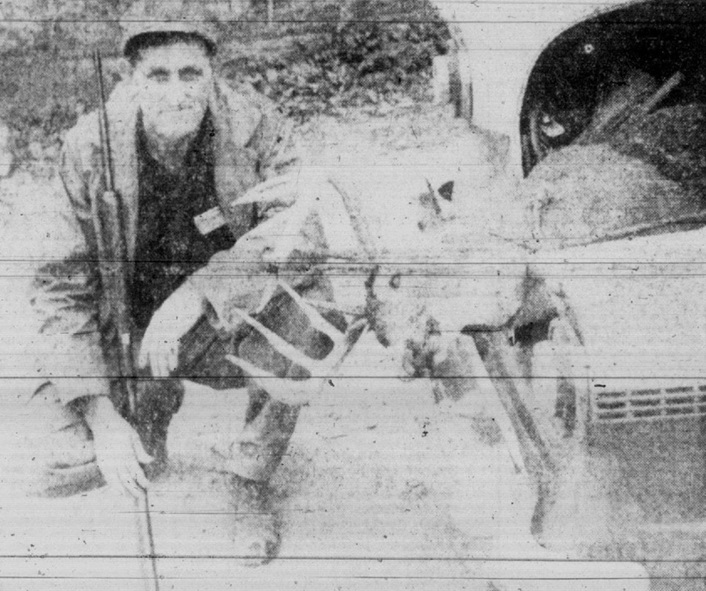
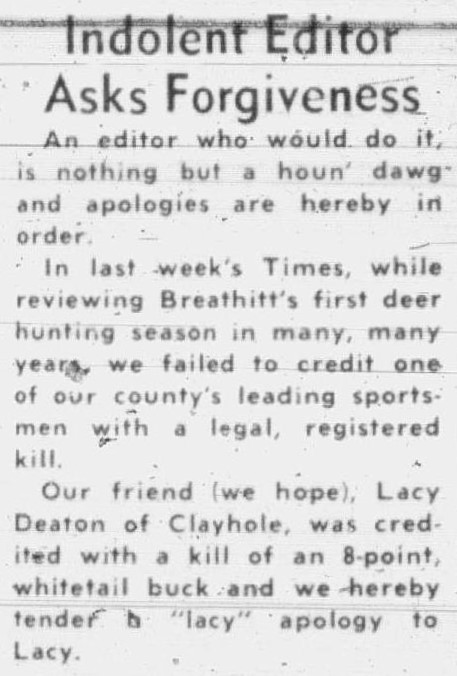
The Jackson Times forgot to to mention Lacy Deaton as one of the succesful hunters on November 8. The printed this apology on November 22, 1956.
Bach also commended forestry division employees who furnished their services and short-wave radio equipment during the hunt.
Seven Breathitt countians bagged does in the course of the three-day season, but Knott County hunters were credited with the greatest number killed. A Mr. Collins from Letcher County checked in with the largest deer.
Bach said the age of deer killed averaged 34 years, and weights varied from 150 to 209 pounds, the dressed weight of the 12-point buck killed by Collins.
Breathitt hunters getting their one deer hunt were Ernest Noble, Elvin Terry, Kelly Stidham, Thomas Clemons, Jack Brown, Swango Clemons, and Jeff Marshall.
Only five law violations were reported during the three-day period: one for killing a doe, two for failure to purchase the special permit, and two for hunting with improper licenses.
The dark side of the picture saw five does reported wounded and killed, with two of them recovered by conservation officers.
Bach said that officers and state biologists were impressed with the success of the first three-day deer hunting season in more than two decades and again expressed his thanks to the hunters for their excellent cooperation.
The Jackson Times, November 15, 1956, page 1
Henry Drake of Powell County ventured to Breathitt County, where he took an eight-pointer early on November 8.
Interest in deer hunting grew in Breathitt County, and the regulated 1954 hunt helped improve the understanding of the health of the state’s deer population. Through the ensuing decades, hunting seasons were added and expanded. Deer populations grew; by 1998, it was estimated that the state was home to more than 450,000 whitetails.
At the start of the 2023 deer season, the Department of Fish and Wildlife estimated that Kentucky was home to 985,386 whitetails. Hunters harvested 140,811 deer in 2023 in four zones during seven different seasons. During the 2023-2024 hunting season, Breathitt County hunters culled 555 whitetails from the state’s herd.
Deer hunting is one of the most popular sporting activities in Breathitt County. Hunters often schedule their vacations and time off to coincide with the season’s opening. Since that first modern hunt in 1956, the number of hunters and the population of deer have increased. The 1956 successful modern hunt encouraged outdoor enthusiasts and helped hunting become one of Breathitt County’s favorite pastimes.



 Bookie on the Trail