By Stephen D. Bowling
“Cood” Bowling lay nearly lifeless on the floor of his cell at the Breathitt County Jail when they found him. His face was pale. The jailer said Bowling’s lips were “as blue as they could be.” It was believed that he was already dead until he released a deep groan.

The “Army Doctor” and several soldiers from the Louisville Legion, who were stationed around the Courthouse Square to protect the court system, rushed into the jail to render aid to save Cood’s life. Three local doctors were also called to the jail. The Breathitt County News reported that they “worked heroically and persistently with him all Monday afternoon” and on into the night, but they could do little. He never regained consciousness. Elijah Bowling died “a few ticks” after 7:00 Tuesday morning from a self-inflicted morphine overdose.
In the early 1900s, Elijah “Cood” Bowling gained a reputation as a rough man around Canoe and Jackson. He had a long history of scrapes with the law and violent episodes that resulted from his quick temper. His runs of “troubles” were about to come to an abrupt end. On September 28, he awoke in the Breathitt County Jail awaiting a court hearing for the murder of Boyd Griffith.
Elijah “Cood” Bowling was born to Elijah and Zilpha (Baker) Bowling on April 12, 1878, in a small cabin on Canoe Fork. As the youngest of twelve children, he learned early to defend himself against the roughness of his five older brothers, and he was “doted on” by his six sisters as the baby of the house.
He attended the Canoe School but only completed the fifth grade and part of his sixth before the field required his day’s work. Cood started spending extra time with Mary Ann Stamper, the daughter of Elizabeth Stamper of Canoe. In January 1898, the two had a child, John G. Bowling, together, although no evidence exists that they were married. Cood married only once. On May 1, 1900, the Reverend Nathan L. Arrowood performed the marriage rites for Cood, 22, and nineteen-year-old Nancy Clay at the home of Harrison Strong near Whick.

During the hottest parts of the feuds of the late 1890s and early 1900s, Cood Bowling, his brothers Ewen and George, along with several nephews and other relatives, worked at various times for the Hargis-Callahan organization. They gained a reputation as “gunmen” and hotheads who were willing to complete nearly any mission, from assault to intimidation and beyond. They were active during the election season and frequently canvassed and cajoled voters for the Democratic ticket. In exchange, they received gifts of money and guaranteed protection from arrest and prosecution. Together and independently, the Canoe Bowlings found many “troubles.”
Cood’s last troubles came to a head on September 19, 1903. Bowling and a neighbor, Boyd “Boss” Griffith, met on Griffith’s farm to negotiate the trade of a team of horses. Griffith had a matched team of horses, and his nineteen-year-old son, John Griffith, was with him. Bowling and Griffith had finally made amends after several years of disagreements related to a school board election in 1898. They were sociable, and neither feared the blaze of a gun from the other.

After several minutes of discussion, the men disagreed, and a quarrel ensued. Bowling said Griffith was trying to cheat him for a team past its prime. Griffith said that his valuation was correct. Griffith turned to take the team back home.
Bowling reportedly charged at Griffith and threw a “huge rock,” striking Griffith nearly on the top of his head. Boss Griffith crumpled to the ground without a sound. John Griffith, the only known eyewitness to the attack, ran to a nearby house for help as Bowling mounted his horse and rode away.
Neighbors who came to the scene of the attack did not hold much hope for Griffith. His wife, Nancy (Sebastian) Griffith, soon arrived. They loaded Griffith onto a wagon and started over the mountain to the railroad hoping for better medical treatment in Lexington. Riding ahead, a neighbor convinced the Lexington & Eastern afternoon train conductor to hold at the Athol station while the injured man was brought to the train. The engineer waited more than half an hour before the wagon came into sight, and the patient was loaded into a baggage car.
Griffith arrived in Lexington at 6:30 p.m. on September 19 and was carried by ambulance to the St. Joseph Hospital. Doctors assessed his condition and pronounced the case “likely fatal.” Doctors told The Lexington Herald-Leader that Griffith had a “concussion of the brain.” He was rushed into emergency surgery when doctors removed several “particles of the fractured skull” that were embedded in the brain. They described the wound as “crushed in on the right hand side almost on top of the head.” They said that a large amount of clotted blood had been removed from the wound and that every effort was made to “relieve the patient’s condition.”
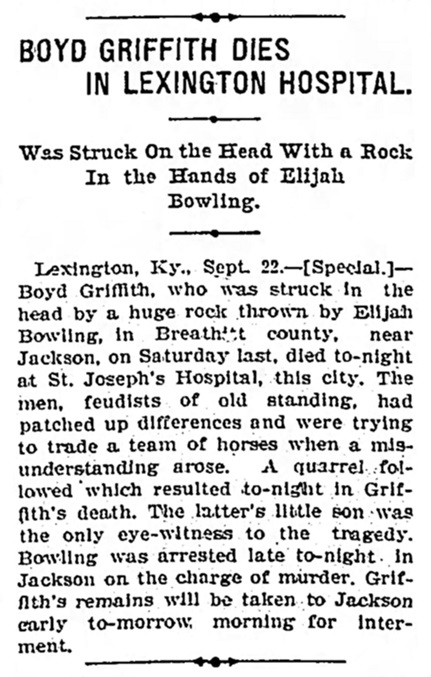
A reporter from The Lexington Herald-Leader remained at the hospital hoping to get more information on just another bloody affair from Breathitt County. A late evening update was printed in the newspaper with the headline: “Still Alive at 3:30 A.M.” The brief update reported that Griffith was alive but “weak from loss of blood.” Nancy Griffith stayed at his side.
In Lexington, Griffith continued to fade. The medical staff at the St. Joseph Hospital did not believe that Griffith would live through the night, but he did. His condition showed some signs of improvement on September 21st until late in the afternoon when a low wheeze could be heard in his right lung. His wheeze turned into a “rattle,” and he rapidly deteriorated during the evening. Boyd Griffith died on September 22, having never reopened his eyes.
Boyd’s brother, John Griffith, claimed the body and accompanied it to Breathitt County. They loaded the casket into a small wagon at the Athol Depot and made their way to Sebastian’s Branch. Services were held on September 24, 1903, at the Griffith Cemetery on Sebastian’s Branch, with a large crowd of family and friends gathered around.

Late in the morning of September 19, while Griffith lay in a Lexington hospital, John Griffith went before Breathitt Couty Justice of the Peace James W. Edwards to provide information about the assault. Edwards wrote out an arrest warrant for Bowling and sent Deputy Sheriff Bob Deaton with four soldiers from the Louisville Legion to Canoe to find him.
Deputy Deaton and the soldiers found Bowling sitting on his porch, calmly smoking his pipe as they rode up the road. Bowling surrendered without incident and left with the officers. He was lodged in the Breathitt County Jail on the afternoon of Saturday, September 19. Bowling, a former paid “protector” for Ned Callahan during the feuds, was given a comfortable cell and fed a “good meal.” His family was permitted to visit, and several of his brothers stopped in to discuss the case with Cood.

A preliminary hearing before Judge James H. Hargis was scheduled for Saturday evening but was postponed as news of Griffith’s worsening condition arrived at Jackson by telegraph.
When word arrived that Griffith had died, Judge Hargis rescheduled the hearing for Saturday, September 26, but changed the date later that day to Monday, September 28, so that Griffith’s son, John, could testify about what transpired.
Elijah Bowling was brought in handcuffs into the courtroom on Monday, September 28, as Judge Hargis heard evidence about the incident. Bowling took the stand and told the Court that he and Griffith had disagreed. He told Judge Hargis that Griffith picked up a large rock and threw it at him, barely missing. Bowling said that he picked up the same rock and hit Griffith in self-defense.
Hargis, surprisingly to many observers, found probable cause and held Bowling without bail. Most in Jackson knew that Bowling had done some “work” for Hargis and Callahan during the most recent round of Breathitt County “disturbances.” Hargis sent the case on to the Grand Jury for indictment. Bowling went back to his cell at the Breathitt County Jail with his head low after he expected to be released by Judge Hargis. Instead, Hargis set the trial for the November term in the Breathitt courts.
Ewen Bowling, Cood’s brother and a well-known associate of feudists and an indicted Hargis co-conspirator, visited his brother at the jail. During his visit, Cood Bowling asked his brother to take fifty cents and get him a dose of morphine to help him sleep. Bowling told his brother and others that he had “a terrible night of sleep.” He told anyone who listened that the “ghost of the murdered Griffith was in the cell with him.” Ewen Bowling walked to Main Street and returned with the small vile containing several doses that Cood had requested for his own relief. He took the entire viole at 2:30 p.m. and was found on the floor a short time later.

Bowling reportedly died at 4:30 p.m. on September 28, and the news was quickly wired to Lexington for the newspapers to print. Passengers on the Lexington & Eastern evening train also brought confirmation of Bowling’s death. The following day, the Lexington paper printed a correction to the story of Bowling’s death after an update. The editors wrote: “Elijah Bolin, the slayer of Boyd Griffith, who was reported to have died Monday night from the effects of morphine administered by his own hand, did not die till yesterday morning.”
An article in the September 30 edition of The Lexington Morning Herald provided more details of the death mix-up and Bowling’s bizarre resurrection. According to accounts, Bowling died on a small table in the jail. Doctors William P. Hogg and Woodson Taulbee pronounced Bowling dead. The report indicated that Bowling lay on the table where his “heart stopped beating” for more than twelve minutes. Dr. William N. Offutt started to move the body and administered “artificial respiration and moving his arms up and down.” Bowling miraculously came back to life and started to move and moan.
He lived until 7:00 a.m. the next morning and died on September 29. All three doctors declared him dead this time. There was no resuscitation.

Later that day, a coroner’s inquest determined that Elijah “Cood” Bowling had ingested several doses of morphine (more than one eight of an ounce) and had done so with “suicidal intent.” The inquest found that the dose had been procured from the Hogg pharmacy by Bowling’s brother, Ewen, who was seen leaving Jackson “rapidly” before the overdose was discovered. The coroner’s jury also announced that it was not “known as to whether he knew anything of his (brother’s) intentions.”
His passing did not go unnoticed by the Kentucky press. The Lexington Herald-Leader ran an article/opinion piece on page 4 of its September 29, 1903 paper announcing the death of Bowling. At the end of the article the writer included his assessment of the passing of Elijah Bowling.
Tragic as the case may appear, the removal of Bolin by his own hand from the list of Breathitt criminals is looked upon here as a propitious sign. The people believe that the trial of Jett and his conviction and the general clarifying of the criminal atmosphere by the sending of troops and the enforcement of law by physical strength, as it were, has had a good effect and that Bolin, reasoning that his chances to be acquitted were slim, took his own life rather than face the consequences which meant at best a long term in the penitentiary. The fact that Hargis felt the necessity of considering the case seriously and not turning him loose as has often been the case with criminals here, is looked on as another favorable sign.
More than a week later, on October 8, The Lexington Herald opined a second assessment of the impact of Bowling’s passing.
Of course, nobody is worried over Bolin’s departure, and Breathitt can give him up without loss of sleep over her bereavement, but the lesson the affair leaves on the public mind is simply this: The backbone of lawlessness is broken in Breathitt.
Following the inquest, the body of Elijah “Cood” Bowling, only 25 at the time, was taken by wagon to his home at Canoe. Rev. Nathan Arrowood delivered the “long, meandering sermon” about the wages of sin, and Cood was buried in the William Stamper Cemetery on Stamper’s Fork.
His grave is unmarked.

Author’s Note: I am indebted to Archie Bellamy, Elijah Bowling’s nephew, for many of the details and quotes contained in this writing. “Papaw Arch,” as we called him, helped spark my love of history and provided hours of conversations and thousands of details to a young boy who had many questions in his quest to find history. I am forever thankful for the years I had on Lick Branch with him and the opportunity to listen to his stories and laugh along. He and his stories enriched my life.
© 2024 Stephen D. Bowling

 Bookie on the Trail