By Stephen D. Bowling
It was a typical February rain. Long-time mountain residents were used to these late winter storms and the floods that followed. Most mountaineers expected “one good tide” near the end of February each year, and in 1972, that pattern continued.
During the last week of February 1972, a moisture-packed low spun its way up the Mississippi Valley and slammed its warm air into cold air hovering in the Northeast. The result was three days of heavy rain and storms.
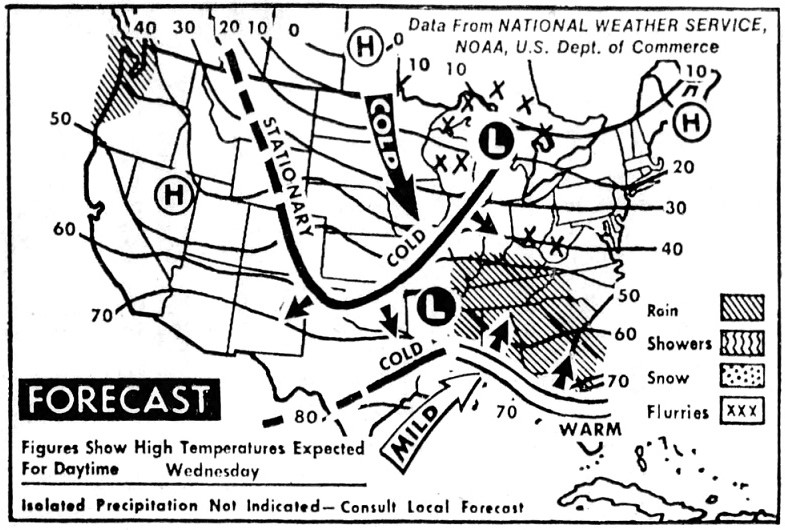
The first raindrops fell on Wednesday, February 23, and continued for three days. The Jackson Times reported that a local weather observer recorded more than four inches through the day on February 24 into the evening of February 25. The rain ended shortly after midday on Saturday, February 26, but the heavy runoff from upstream found its way north to Jackson. Residents kept a close watch on the rising waters.

The Kentucky River rose and left its banks. Flood waters entered homes in South Jackson and low-lying areas around Breathitt Couty. Official measurements recorded the river’s crest at 31.56 feet at about 3:00 p.m. on Saturday, January 26, and started to fall. Jackson had dodged a bullet with the flood, but two city employees were dead.
The water did cause several issues in the city. The tide covered several streets with thick, muddy sediment. As the water rose, residents along the river reported sewage backing up into their homes on Friday, February 25. Several residents called the Jackson Water and Sewer Department to report the problem.
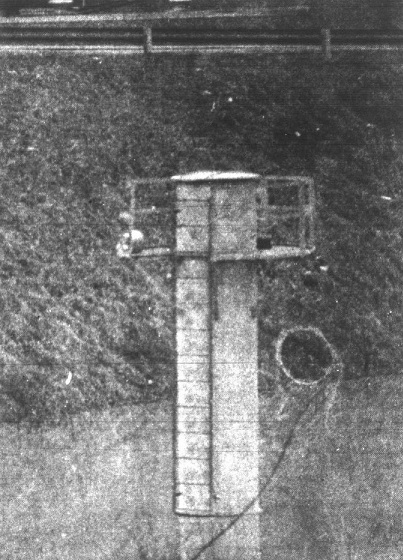
Waterworks Superintendent Dailey Sallee took two workers to the sewer lift station along the river. They discovered the station was offline due to the flood waters. Sallee, Paul Ray Goff, and Charles Edward “Rabbit” Frazier worked at the site most of the day. They gained access to the lift station and decided to install a gas-powered pump temporarily in the station to help send the sewage to the treatment plant.
The pump worked, and the sewer issues were resolved as long as the pump ran. The workers left to check another lift station. About an hour later, they returned to find the temporary pump, located at the bottom of the three-foot tube nearly thirty-seven feet in the ground, had stopped. They suspected the pump’s engine was out of gas. Frazier started down into the confined space to retrieve the pump so the workers could refill its gas tank and restart the pumping process.
“Rabbit” climbed about 27 feet down the ladder, slipped on a rung, and hung by one arm for a few seconds before dropping ten feet to the bottom of the station. The men at the top of the lift station shined their light into the tight space and yelled at Frazier, but he did not move or answer.
Paul Goff swung his leg over the side of the tube and started down to get him, thinking he had missed a step and fallen. He yelled back up and told the other workers that the fumes were bad. He told them that he was light-headed and growing weak. At about the same level where Frazier had fallen, Goff stopped and tried to climb back up the ladder. Witnesses said he “acted like his feet were heavy,” and he could “not even lift them to climb up.” He fell to the bottom of the pit, landing on Frazier.
Both men lay at the bottom of the sewer lift station, lifeless and most likely already overcome by the methane gas and carbon monoxide fumes from the temporary gas pump.
Larry Plummer, who had come to the lift station, volunteered to go in to save the two men. He encountered the same fumes at about the 27-foot level. The Jackson Fire Department and an ambulance were already headed to the scene. Risking his own life, Plummer went back into the lift station and managed to get to the bottom while holding his breath.
Plummer tied a rope around his waist and ventured back onto the scene. He managed to reach the bodies and tie a rope around the bodies of Frazier and Goff. Running out of breath, Plummer took a large breath and started to show signs similar to those experienced by the two men he was attempting to rescue. The men at the top of the opening hoisted him to the surface, but the fumes overcame him. Ambulance workers administered oxygen to Plummer, and within minutes, he was revived.


The bodies of Frazier and Goff were pulled to the surface, but it was too late. The fumes and gas had claimed two young victims. The lifeless bodies of Ray Goff and Charles Edward Frazier, both 27, were taken to the Lewis Hospital here but were pronounced dead on arrival. Breathitt County Coroner Dean Spencer came to the lift station and opened a death investigation. After talking to the witnesses and reviewing the scene, he ruled the deaths accidental.

Witnesses said there was “no known danger” at the work site. Sallee reported that his men “had been in and out of the pit that very day.” Visibly shaken, Sallee told Spencer that “everything possible was done to save them.” For Frazier and Goff, it was too late for their efforts.
Spencer went to Dr. F. C. Lewis’ office on Mian Street. Both men’s bluish skin and darkened fingernails indicated signs of cyanosis from the lack of oxygen. Spencer pronounced both men dead of asphyxiation and filled out their death certificates.
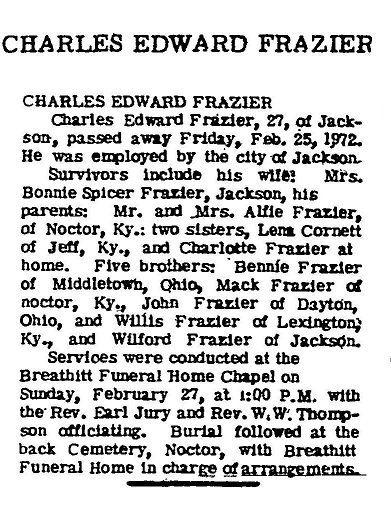
The hearse from Breathitt Funeral Home took the body of Charles Edward Frazier. His funeral was preached on February 27 by Rev. Earl Jury and Rev. W. W. Thompson. His widow, Bonnie (Spicer) Frazier, two sisters, and the five brothers mourned his death. He was buried in the Frazier Cemetery lot on Quicksand near the Lazarus Back Cemetery.
Funeral services for twenty-seven-year-old Paul Ray Goff were held on February 28 at the Goff home in Jackson. His wife, Glenda, sat near the casket. He was survived by two sons, Davis and Michael, parents, Ollie and Violet (Yeary) Goff, two grandmothers, three brothers, and three sisters. Goff was buried in the Jackson Cemetery on Monday, February 28.

The February 1972 flooding event is not remembered for its destruction, but for the tragedy, it left in its wake. River levels would invade the town again a few months later, in April. Improvements were made to safety at the sewer and water plants. The state and federal inspectors provided some training and increased awareness of the dangers of confined spaces and gas levels.
Today, safety regulations and OSHA guidance govern entry into confined spaces. The Jackson Fire Department trains for confined space rescues and methods to monitor and mitigate gases. A repeat of the tragic 1972 deaths has been avoided through training and the implementation of best practices.
The legacy of the tragic deaths of Charles Frazier and Paul Goff is the safety of our city and county workers who face dangers every day as they work to keep our water and sewer flowing. Little thought is given by most people to the risks they take and the challenges they face every day. The only thought most have is to complain when the smell is strong and the faucet is dry. Take time to remember those who work hard and face danger every day to make your life easier.
© 2024 Stephen D. Bowling

 Bookie on the Trail