It was the worst flood that Breathitt County had seen in years. Several days of rain in Breathitt County and especially upstream in Perry, Knott, and Letcher Counties fell onto several inches of snow and frozen ground. With the run-off, the river rose quickly at Whitesburg through the day on January 27 and January 28. The Kentucky River reached its peak in Letcher County on the afternoon of January 29, 1957, at 14.70 feet at the river gauge in downtown Whitesburg.
The “tide” rushed down the Kentucky River Valley. The waters of Kingdom Come, Rockhouse, Line Fork, Leatherwood, Maces, Carr Fork, and hundreds of smaller tributaries emptied their drainage into the river as it surged toward Hazard. At Hazard, the river rose quickly. Families scrambled to get household goods up to higher ground. The river jumped its banks and flowed through homes and down the streets of Hazard. By dawn on January 30, 1957, the flood waters at Hazard reached 37.54 feet, setting a new record for the Hazard gauge.
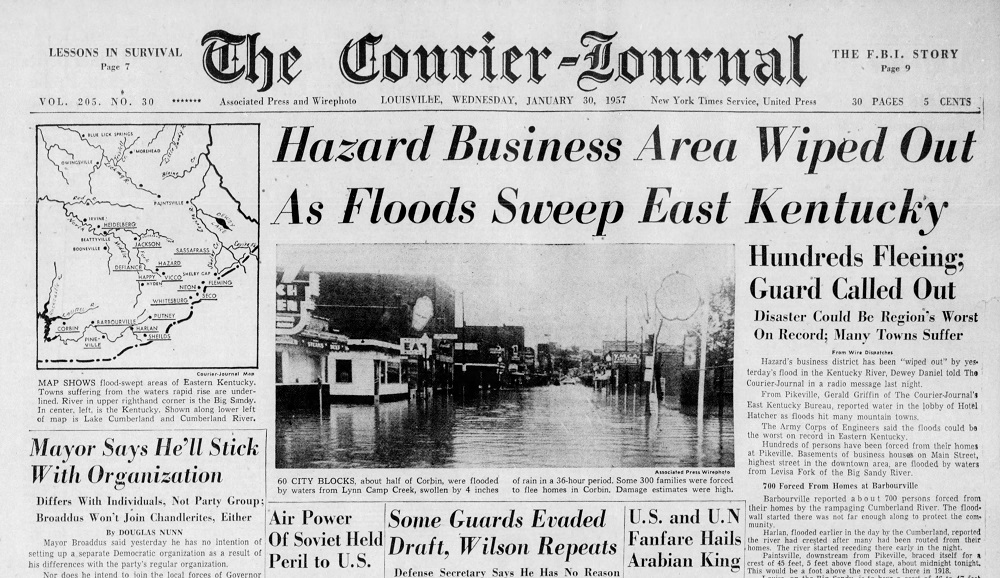
Some of the destruction at Hazard was detailed on the front page of The Louisville Courier-Journal on January 30, 1957. The newspaper also provided details of other flooded communities in the state.
Hazard suffered greatly with the destructive power of the surging force of the water and later with the feet of sticky and foul-smelling mud. Thousands of homes and businesses were carried away or damaged beyond use by the inundation of water. Perry County was isolated as train service stopped, and highway access was closed as the waters continued on northward toward Jackson. The river levels grew as Grapevine, Caney, Little’s, and many more creeks emptied into the river.
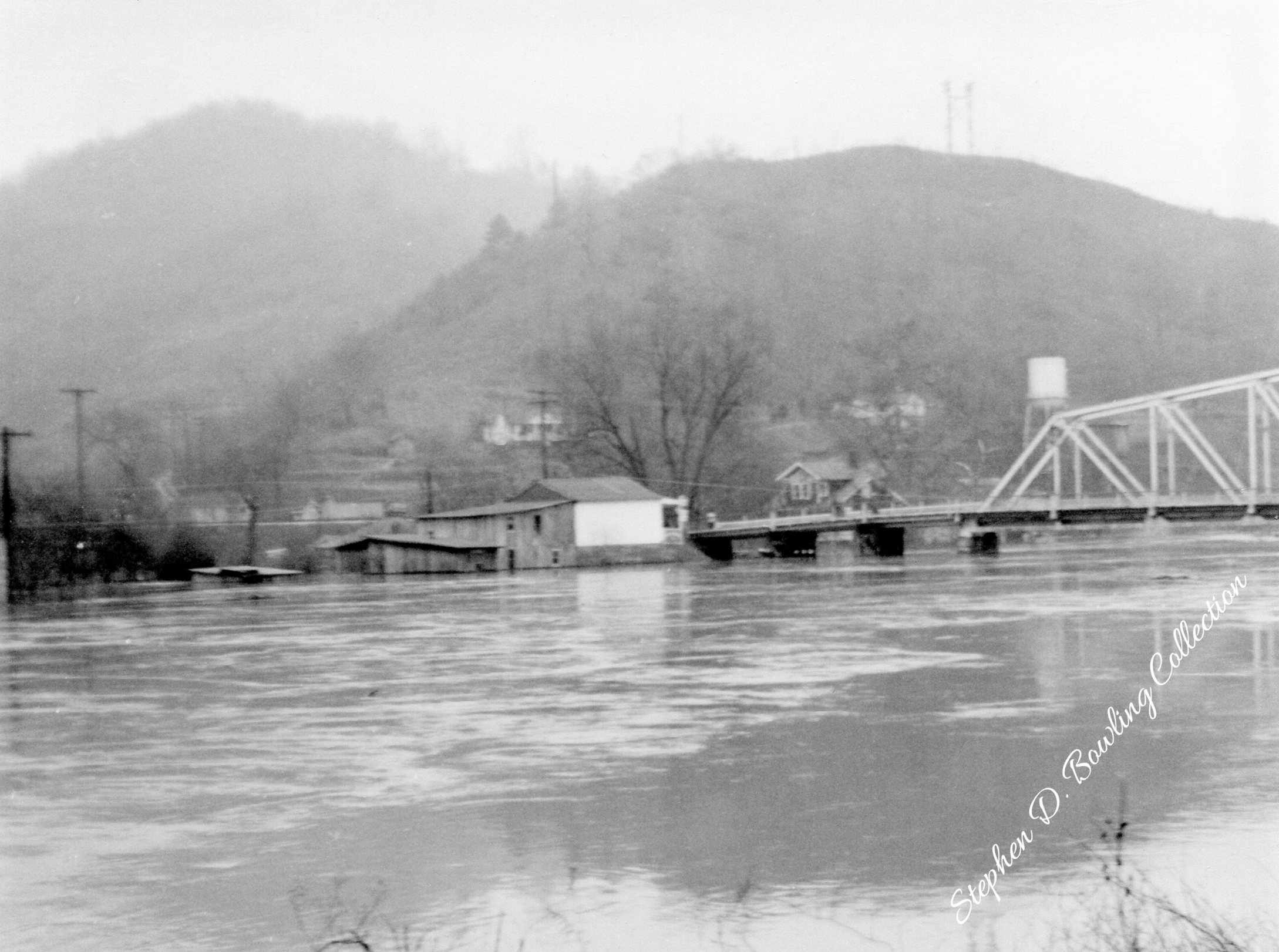
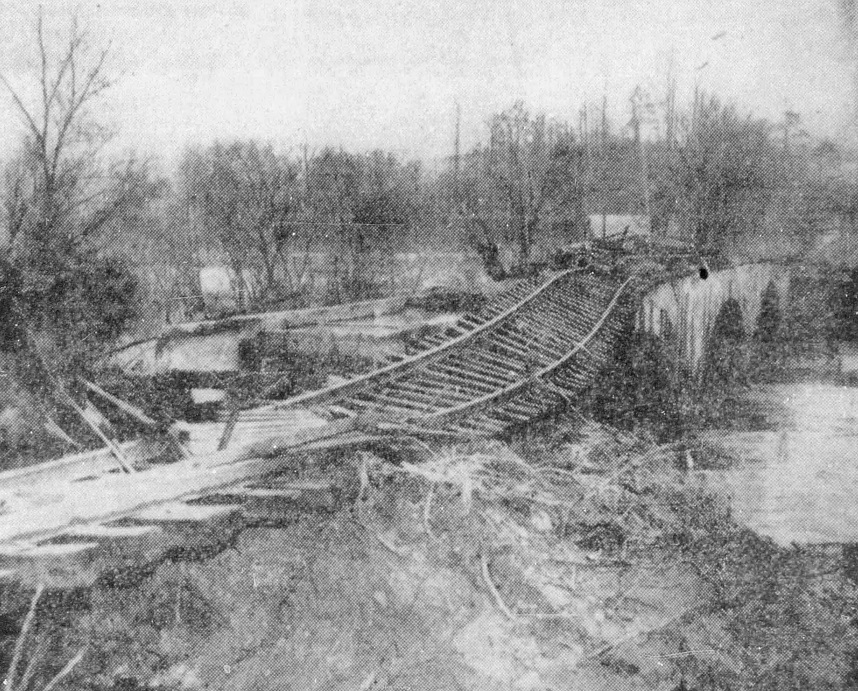
Near Haddix, the rushing waters of the North Fork, filled with dead animals, destroyed vehicles, and the remnants of structures swept off their foundations, joined forces with the waters of Troublesome Creek less than a quarter mile from the Haddix Bridge. The two-hundred-foot long, double-span bridge connected the southern portion of Breathitt County with Highway 15 and both Jackson and Hazard. The debris from “up-river” backed up against the smaller southern span of the bridge. Residents of Haddix stood on the railroad tracks and listened to the creaking and popping of the bridge as the pressure from the rushing water stressed the bridge. At 11:00 a.m. on January 30, 1957, the southern section was swept away by the water.
By midday on January 30, the rising water filled many homes in Jackson and had reached Broadway for the first time in years. Flat-bottomed boats made hundreds of trips to homes in South Jackson and the Frog Pond areas to salvage what they could from the houses there. Business and activities in Jackson stopped, and every one-eyed the water which rose rapidly.
The Jackson Times published a small edition on January 31, 1957 (only 6 pages) but was unable to distribute the prints to many areas in the county. The headline of the paper reported the 40-foot water level and the dire situation many in the mountains found with access to limited supplies such as food and electricity. By the time the newspaper hit the stands the following day, some access by road had been restored.
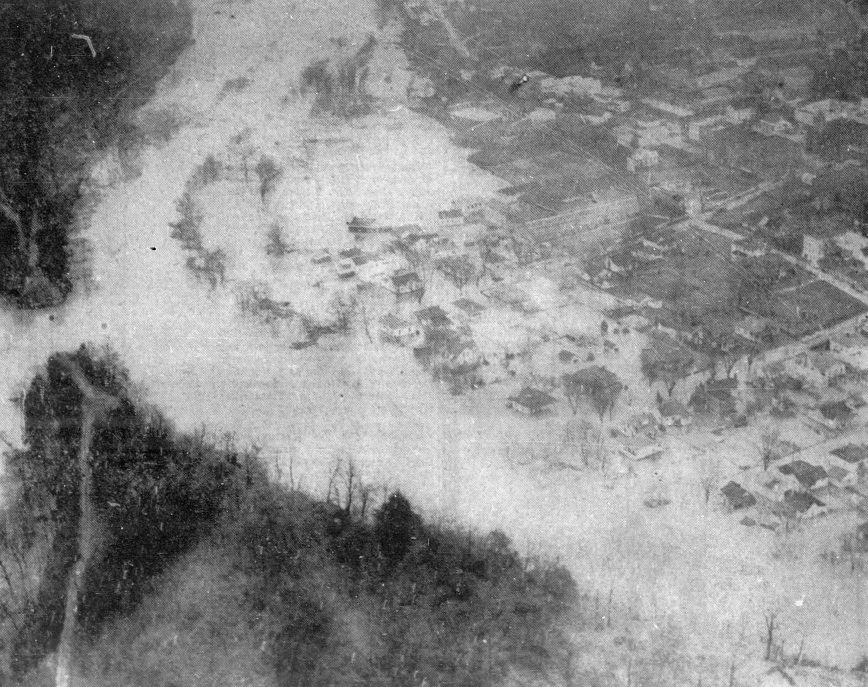
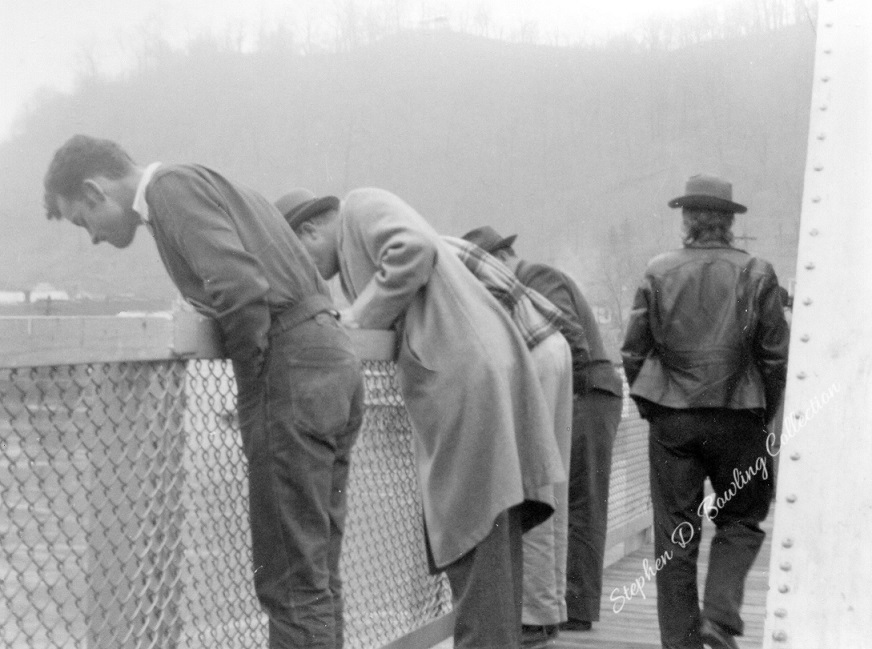
A view of Jackson taken by a Lexington Herald-Leader reporter on January 31, 1957, shows water flowing through the new Cut-Through (on the left).
Crest of 40.6 feet Registered in Worst Flood in 30 years
New Flood Control Project PraisedFor Reducing Damage;
Middle Fork Area Is Hard Hit
Flood waters of the raging North Fork of the Kentucky River hit the crest stage of 40.6 feet at the Jackson Bridge Wednesday afternoon the highest reached by that body of water since the big flood of three decades ago.
Jackson was completely marooned from the outside world all-day Wednesday with telephones the only method of communication available to the public. Switchboards of the local exchange have been swamped with calls since erroneous information was released Tuesday night and Wednesday morning by radio and television news broadcasters.
Several homes in South Jackson and the “Frog Pond” area of the city were flooded and numerous homes had their basements filled with the muddy backwater from the rampaging North Fork.
Captain William S. Dalton mobilized the local National Guard Unit Wednesday morning and about thirty guardsmen were active in moving furniture and evacuating persons from the flooded sections of Jackson.
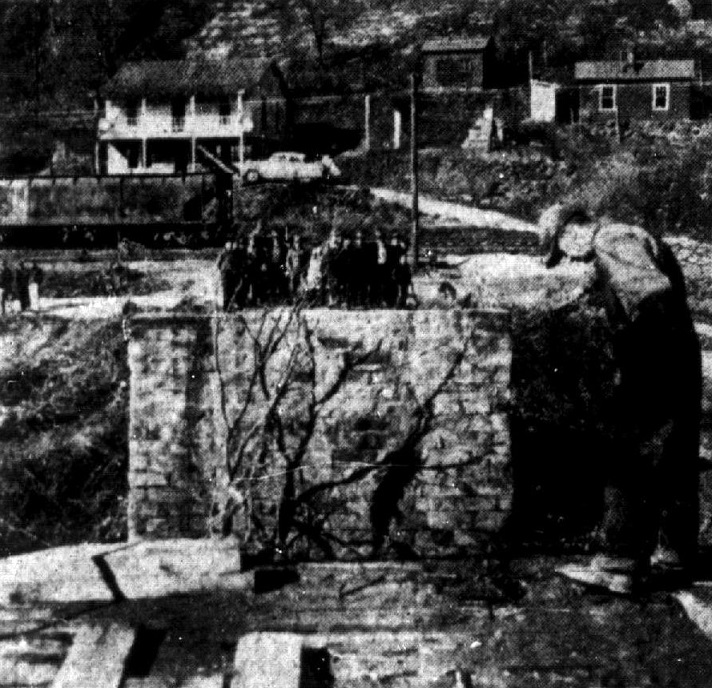
HADDIX ISOLATED — This photo, taken by Joe Reister of The Louisville Courier-Journal, shows the section of the Haddix Bridge which was washed away in the recent flood. Highway Department crews quickly threw up a walk bridge across the span and work is now in progress to connect Haddix with Highway 30. Haddix residents are urging state officials to consider construction of a new bridge across the river there.
The first major test of the recently completed Jackson Cut-Off Flood Control Project proved highly favorable, as experienced river observers were unanimous in their opinion that had it not been for the Cut-Off, Jackson and Breathitt counties would have experienced the most disastrous flood in history.
Scattered reports coming in from the isolated Middle Fork section indicate that that area was the hardest hit with the worst flooding in memory. The Haddix-Lost Creek sections were also dealt heavy losses, the most serious of which was the destruction of the Haddix Bridge, an entire span of which was swept away at 11:00 a.m. on Wednesday.
Traffic is moving today on Highways 15, 11, and 30 for the first time since the flood waters
struck. Food and milk supplies were running low and local merchants were seeing a rapid depletion of their dwindling supplies.
U. S. Senator John Sherman Cooper wired the following message to Acting Mayor B. C. Short:
‘‘I am keeping in close touch with the Corps of Engineers regarding the flood situation. Corps has advised it has directed personnel be sent to the Jackson area to observe and give such help as it is possible. I have talked with the Department of Agriculture, and surplus foods will be available if requested. Call or wire me regarding the flood situation and your urgent needs, as I want to help in every way possible.”
Neighboring Hazard suffered what has been described as the most damaging flood in the history of that Perry County seat. Damages to business houses of more than $5 million have been reported. Neon, Barbourville, and Corbin were also hard hit by flood waters.
Captain Dalton and the local Guard unit left early this morning to do guard duty in Hazard.
The Jackson Times, January 31, 1957, page 1
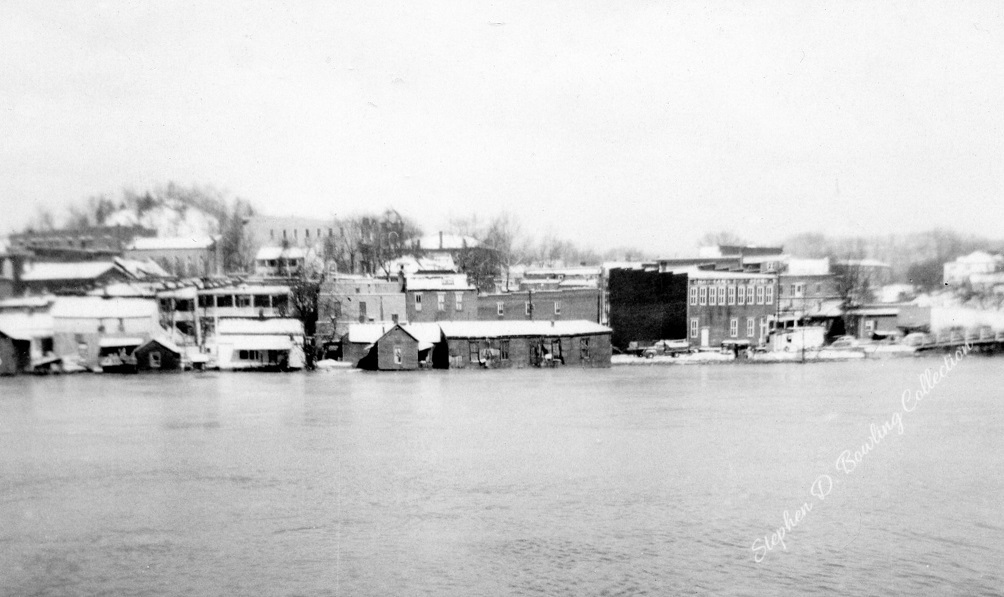
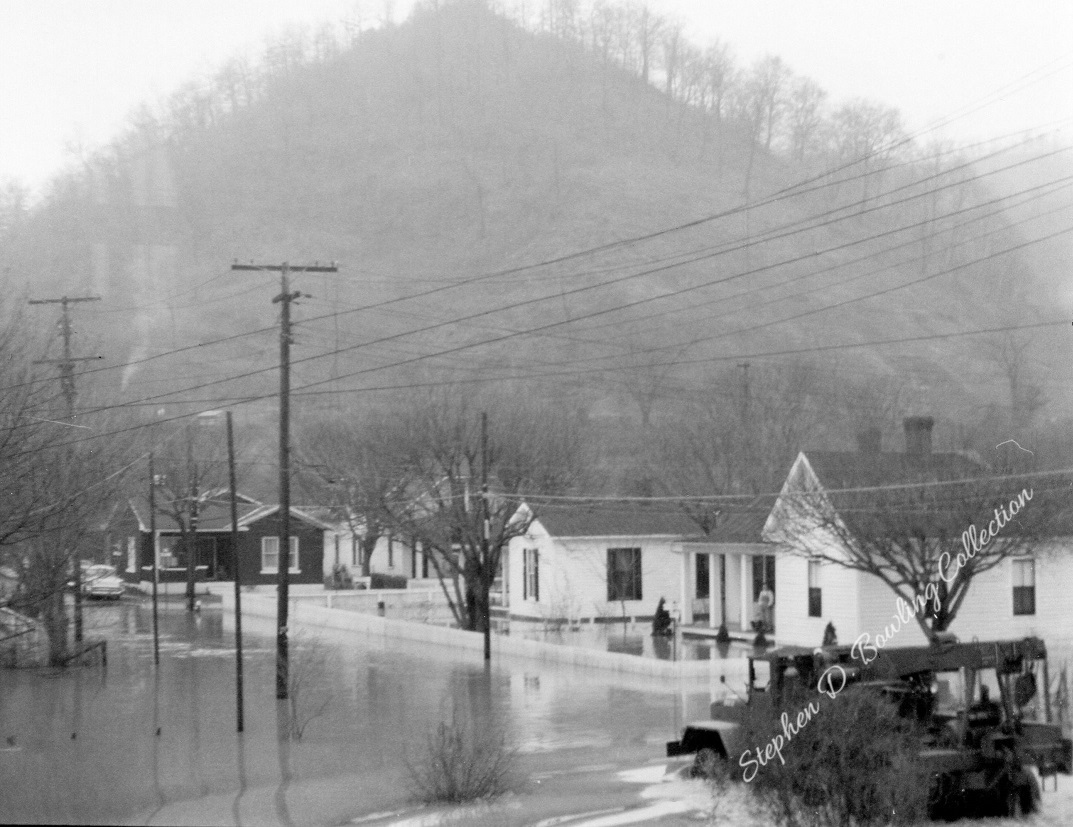
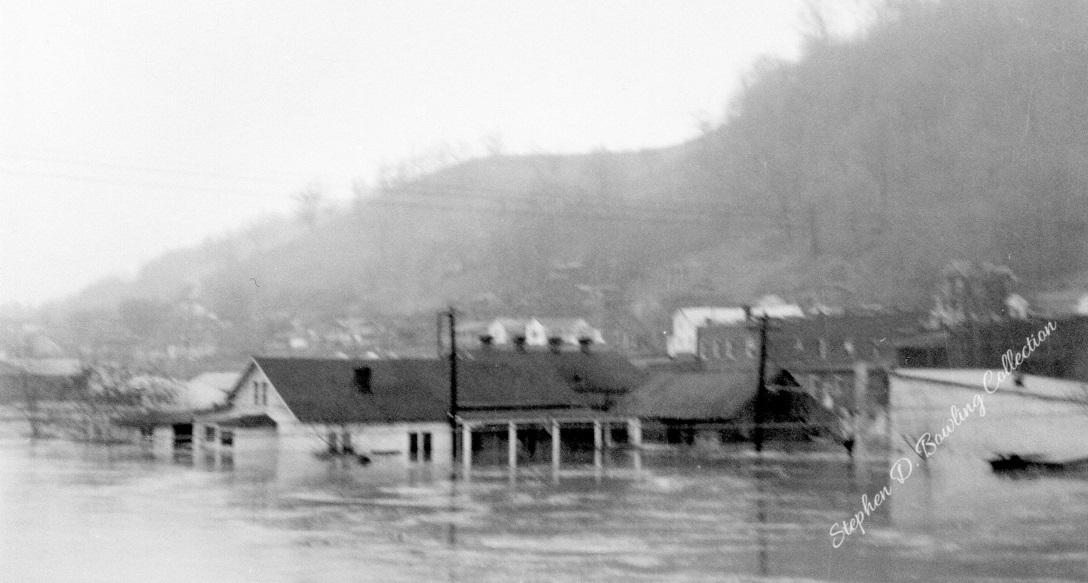
A view of Jackson and the back side of the home and businesses on Sycamore Street as seen from South Jackson on January 30, 1957.
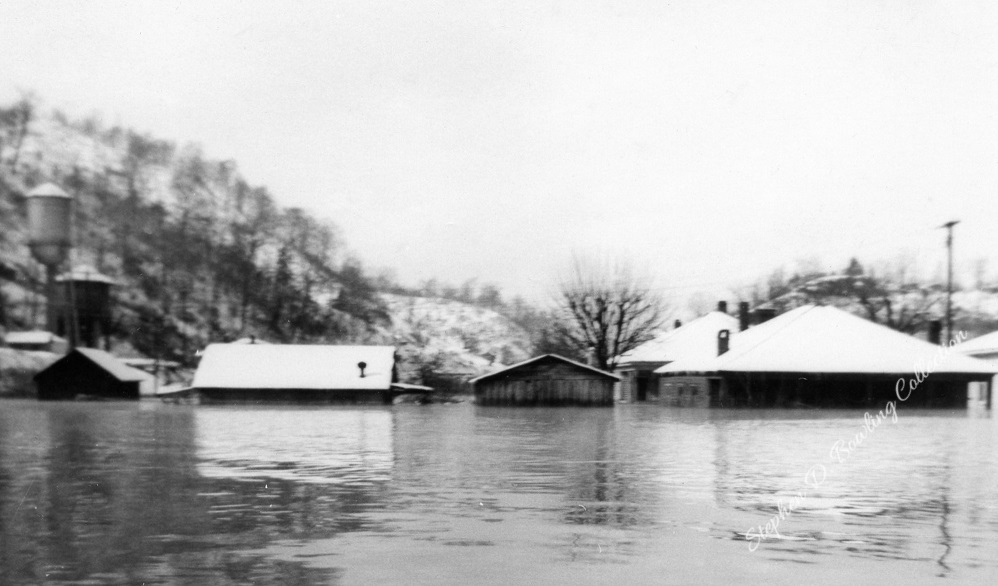
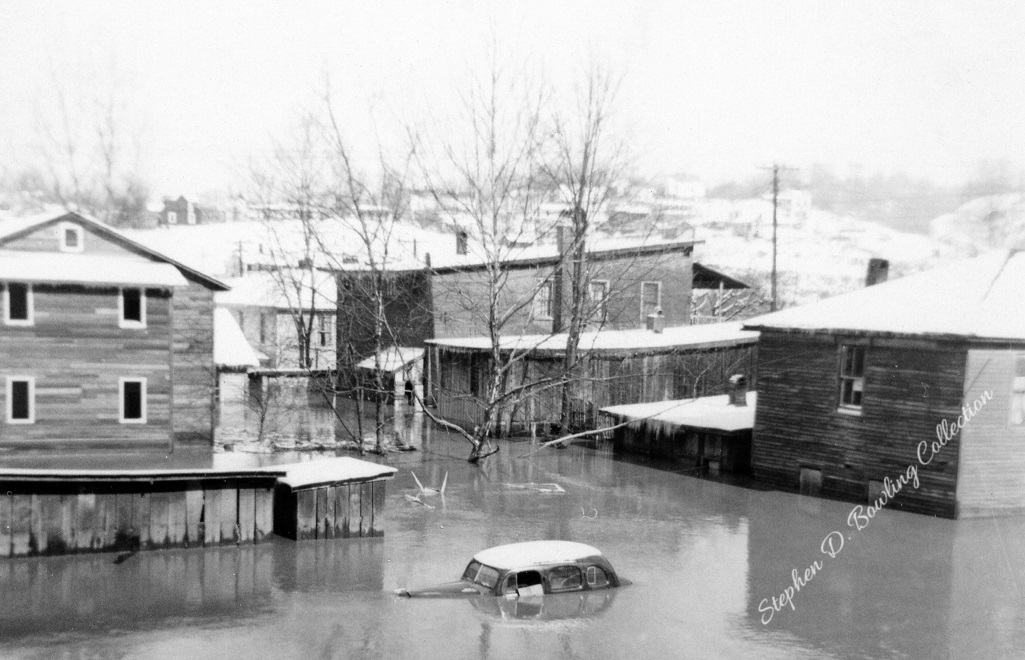
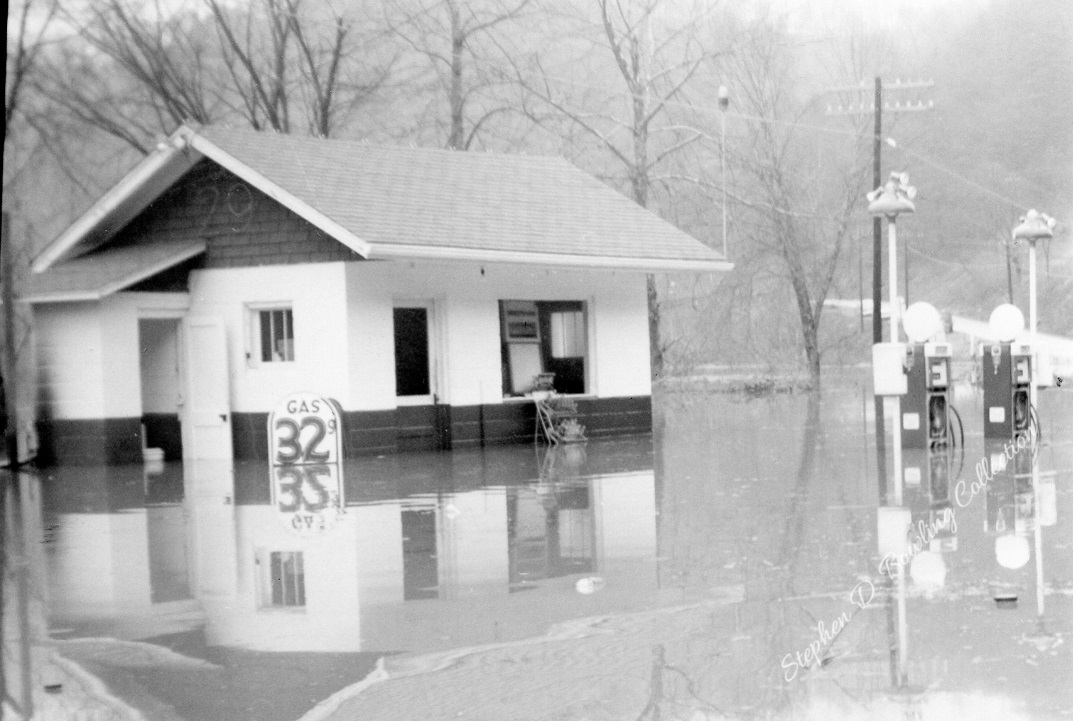
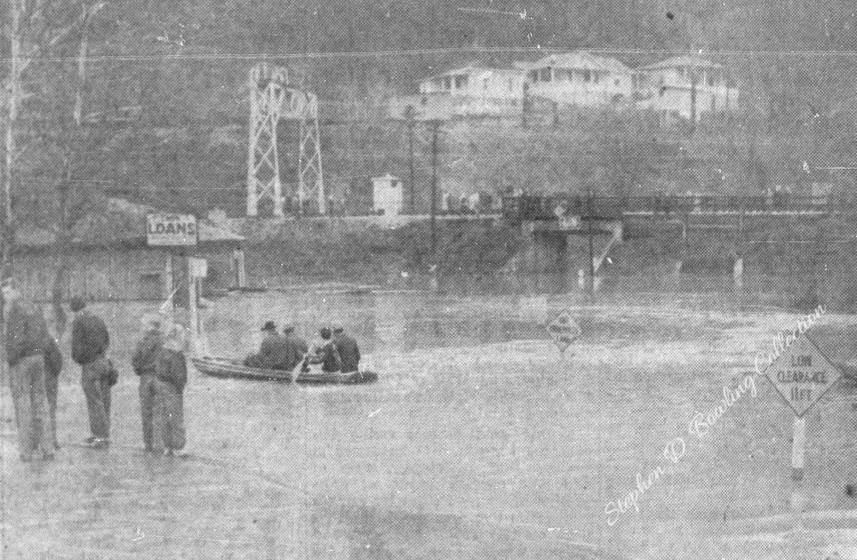
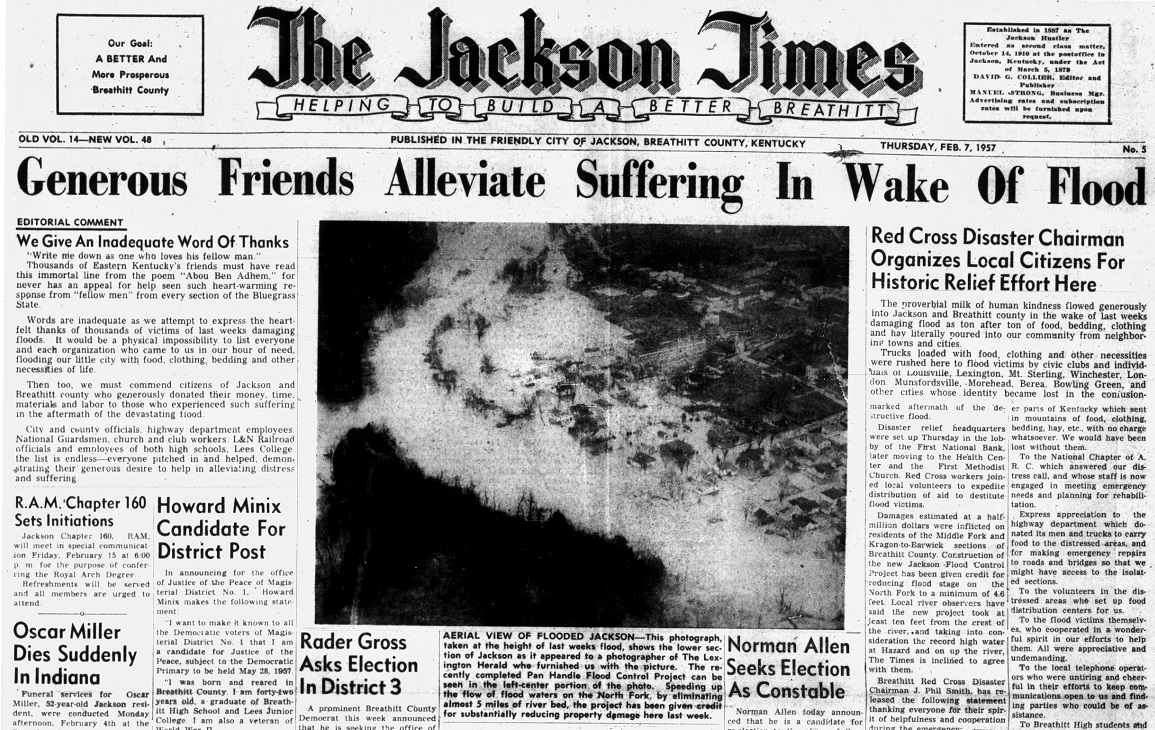
The front page of The Jackson Times on January 31, 1957, was filled with politics and flood news.Views of Jackson during the 1957 flood.
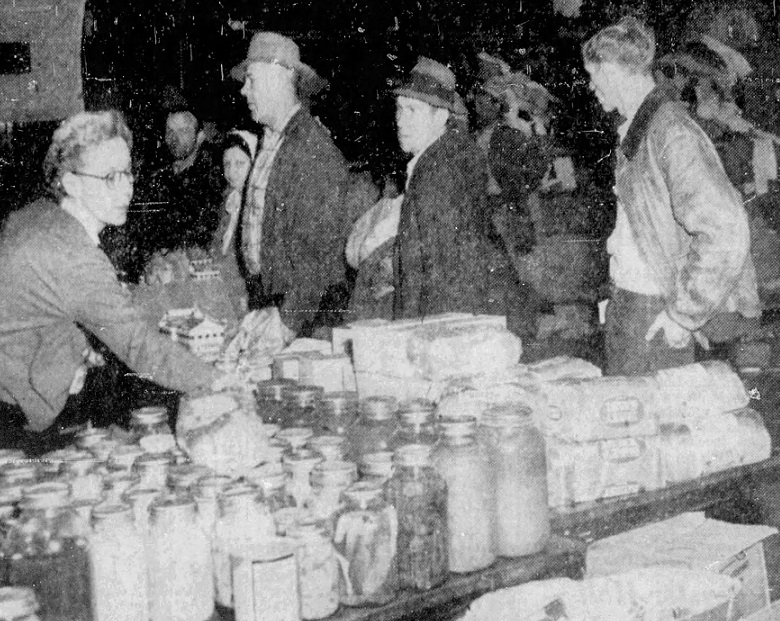
Relief efforts across the state started to meet the needs of the people who experienced this record-breaking event. The flood waters continued on to the Ohio River and inundated nearly every town along the way, including Beattyville, Frankfort, and eventually Louisville and Cincinnati. Donations of food, clothing, household supplies, and money poured in, and agencies across the region geared up to help get the donations to those who needed it most.
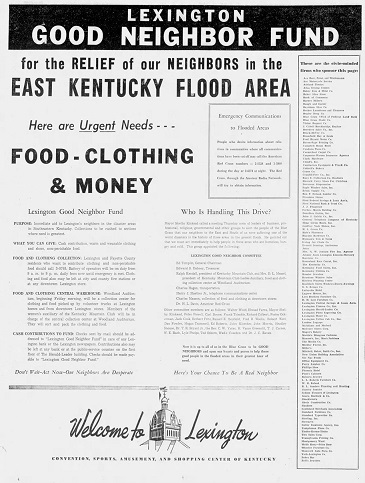
Civic leaders in Lexington started the Good Neighbor project to help serve the people of the state and to meet their needs after the flooding. Hundreds of lads of food and supplies were distributed across the state and in Breathitt County from Lexington’s efforts.
Food banks across the mountain helped feed families, many of whom lost everything to the flood waters. Perry County Clerk Jessie Horn helped man a Red Cross/Salvation Army Center at Hazard’s Memorial Gym.
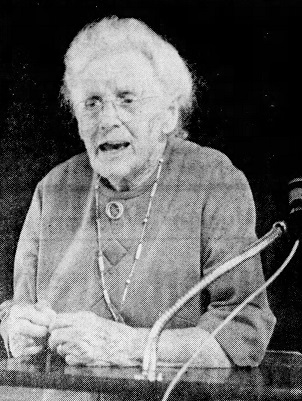
By all accounts, the Middle Fork area suffered the greatest damage from the flooding. Few images were taken of the Middle Fork watershed due to its remoteness and the hard time getting to the area due to damage. Patsy Bratton Turner, the beloved leader of the Canoe School and Mission, sent a message to The Jackson Times detailing some of the devastation that area experienced.
Canoe Woman Tells Of Flood’s Damage
An eyewitness report from Mrs. Patsy B. Turner will give Times readers an idea of the loss and suffering experienced by residents of the Middle Fork section of Breathitt County. Here is the account of the flood-stricken Canoe district as Mrs. Turner relates.
Patsy Bratton Turner continued to serve the Canoe area for many years after the 1957 Flood. She died March 25, 1981 at the age of 105.
“Never was there such a flood in Canoe as we had last week. We worked hard all day Tuesday, putting things up as high as we could, but we failed to get them high enough.
“Only house tops could be seen for some time. And what a fearful sight Wednesday morning of our clothing, furniture, etc., soaking wet, some houses off foundations. Mr. and Mrs. Sam Little’s house is in a bad shape — Patsy Turner’s house off its foundation and twisted — about the only thing to do is to tear it down — furniture destroyed — chicken house in the front yard.
“Rev. and Mrs. Bender have been wonderful, having about 20 at a time in their home, and he has been kept busy watching over the folks in the two communities that were hit so hard.
“Henry Spicer, Henry Turner, Sr., John Wess Turner, Harlan Turner, Richard Griffith, Edgar Turner, Ned Spicer, and Clyce Anderson were all hard hit — got nearly everything they had wet and furniture coming apart.
“We want to thank the many good people of Jackson for the splendid help they gave us in food, clothing, etc. Now, if it was the Lord’s will to take these things from us, we must not grumble, but read Romans 8-28.”
The Jackson Times, February 7, 1957, page 1
The Jackson Times, February 7, 1957, page 1.
Efforts to help those distressed by the flooding received help as soon as the railroad tracks were surveyed and declared safe for use. Trains loaded from locally donated goods, and food and supplies from Lexington and other central Kentucky communities left Jackson headed south by rail. Several truckloads of supplies headed cautiously out Highway 30 West toward the Middle Fork.
The Lexington Herald published a photo of damaged rail lines on February 2, 1957, with the following caption: “FLOOD HAVOC- These railroad tracks leading into Hazard, Perry County, were twisted out of shape by rampaging waters of the Kentucky River, which left more than $5,000,000 damage in the city and damages estimated unofficially at $20,000,000 in the Hazard area alone. (AP Wirephoto).”
L&N Crew Mans Two Flood Relief Trains
L. & N. Engineer Alva Oaks advanced the throttle of the huge diesel locomotive here early Saturday afternoon, sending the first of two relief trains on its way to the Kragon-to-Barwick flood-stricken area.
Loaded with food, clothing, bedding, hay, and other necessities of life, two box cars of relief items went to the residents of that area on Saturday, with a larger shipment of similar goods going the same route the following day.
Highway Department employees and National Guardsmen made similar relief missions by truck convoys to the Middle Fork section.
Crew members on the Saturday relief train, other than Engineer Oaks, were Kelly New, conductor; Hargis B. Gabbard, fireman; Ed Sebastian and Sidney Allen, brakemen; and Edgar Brown, flagman. Other trainmen assisting loading and unloading included B. C. Short, Ervine Allen, Jim Maloney and Floyd Gabbard, Sheriff Carl Back, County Agent George Armstrong, Vince Noble, Gordon Combs, and Walter Fugate.
The train made stops at Kragon, Haddix, Copeland, Little, Whick, Wolfcoal, Altro, and Barwick, where Breathitt Health Nurses, Mrs. Sewell Landrum, and Mrs. Young administered typhoid immunizations to some 122 persons.
Scenes of destruction and desolation greeted the relief train at all stops, and grateful people flocked to the train to receive food, bedding, and clothing.
The entire group of men volunteered their time, and all, including the L&N trainmen, worked without pay. The diesel locomotive and cars were donated free of charge by L.&N officials.
The nimble-footed trainmen, nurses, and other volunteers worked like Trojans throughout the day and into the night and were bone-tired as the train pulled into the Jackson Depot Saturday night.
Sidney Allen, definitely the “live wire”‘ of the train crew, spotting one of the weary nurses nodding from exhaustion, commented: “She would make a good brakeman – she’s learned to sleep on her first run.”
The Jackson Times, February 7, 1957, page 1
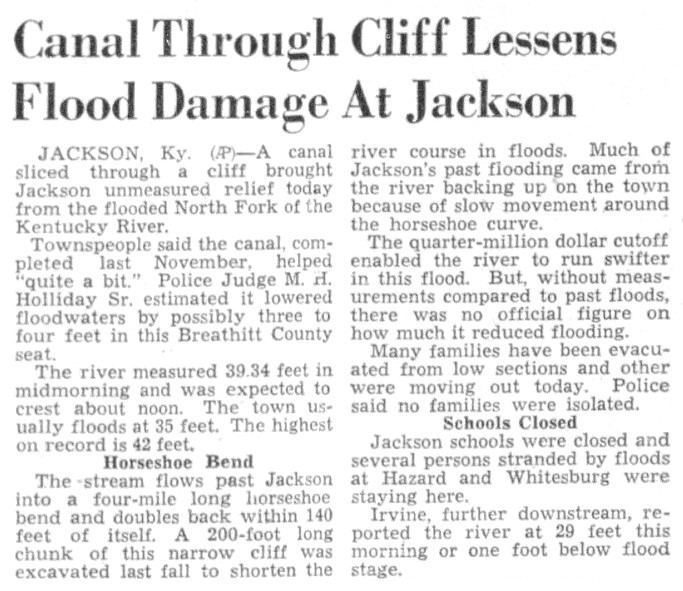
The Lexington Herald-Leader reported that the City of Jackson and the Breathitt County area received millions of dollars in damage but pointed out that the flood could have been much worse. The paper cited that the recently opened Cut-Through project helped lower the level of the flood.
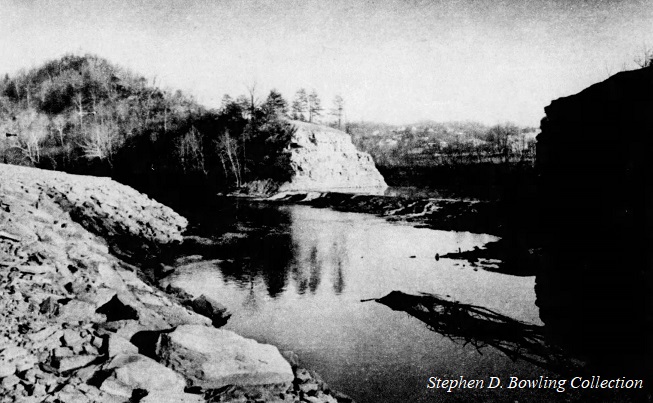
A view of the Jackson Cut-Through just before completion in 1956. The project was credited with reducing the level of the flood level more than four feet.
In the weeks that followed the worst of the flooding in January and February 1957, thousands of families throughout eastern Kentucky worked to recover from the devastation. Destroyed homes, businesses, and lives were rebuilt. According to numerous sources, nine people died in the flooding, and Kentucky sustained more than a billion dollars in damage. The flood would remain as the measure by which all flooding events that followed were measured.
The deluge of 1957 remains the largest flood on record in Hazard. The 1957 records stood for more than sixty-five years until the flood of July 2022 shattered the old record by more than 7 feet.
Breathitt County took a long time but did recover. The 1957 flood now ranks as Jackson’s 7th largest flood behind 1948, 1951, 1984, 1927, 1939 and 2022. The 2022 flood obliterated the record set in 1939 of 43.10 feet when the water at the gaging station on the South Jackson Bridge hit 43.46 feet. Despite its seventh-place ranking, the misery of 1957 lingers in the memory of our community.
Only the 1984 and 2022 floods have surpassed the mark set in 1957. It is only theoretical speculation, but had the Jackson Cut-Through not been in place in 1957, an additional 4-5 feet of rise could be added to the 1957 total raising that level to nearly 46 feet.
Many residents then and now say thank goodness for the Cut-Through.



 Bookie on the Trail