The children of Magoffin and Stella Caudill were excited for Christmas. Thelma, Bobby, Billy, Danny, and baby Judy Caudill looked forward to the holiday and the excitement of what Santa might bring. Small gifts were the norm, and clothing or shoes frequently topped the list. The family always spent a little extra on fruit during the annual celebration of Christ’s birth, depending on what they could afford.
Magoffin Caudill was born on September 16, 1913, to James and Jahazy (Jordan) Caudill. He attended the Sugar Camp School and completed the required grades to graduate. At 22, he married Stella Louise Marshall, the 17-year-old daughter of Meatscaffold residents Logan and Rosa Mae (Back) Marshall. Rev. Walter Creech performed the ceremony on August 25, 1935, at the home of Logan Marshall near Stevenson. The couple settled in a small house at Noctor, where he farmed and worked at odd jobs around the community. He was later hired to work in several coal mines in the Quicksand Creek area.
Magoffin and Stella Louise (Marshall) Caudill
The Caudills welcomed their first child on November 30, 1936, with the birth of Thelma Fern Caudill. More children would liven the home up in rapid succession with the addition of Bobby Gene (1939), Billy Reed (1941), Danny Leroy (1944), and Judy M. in 1946. The Magoffin Caudill enjoyed a close relationship with members of both sides of the family living nearby on Quicksand Creek.
Members of the Caudill family on Quicksand Creek in the 1903s – Magoffin, Judy, Ada, Jahazy (Jordan) Caudill, Ranie, Jim, James Edward, Troy, Cleda, Maxine, Fern, Bill, and Bobby Caudill.
Magoffin worked at his various jobs during the day and farmed their own land at night. Stella managed the house and worked in the home garden. She canned and preserved the food they needed to survive the winter while Magoffin tended to the livestock and ensured they had meat in the smokehouse to feed their growing family.
One meal in 1947 would silently and forever change that family dynamic. The unusually warm start of winter saw the temperatures on Quicksand Creek soar to sixty degrees after the sun rose over the mountains on Friday, December 5. Stella had allowed the kids to play on the porch and even venture out into the yard since it was dry after eleven days without rain. She prepared lunch, which included a large bowl of peas she had canned earlier in the spring and some bread, for the children and called them into the house.
The boys washed and quickly ate their lunch so that they could return to the sunshine in the yard. Eleven-year-old Thelma had not been feeling well for a couple of days and did not eat, choosing instead to remain on the porch. Stella sat at the table holding Judy and ate her lunch. Judy, just 14 months old, could not eat the peas and drank part of a bottle while sitting in her mother’s lap. Not much was left after the children had eaten, so Stella finished the bowl of peas. She washed the dishes and went about her daily chores. Magoffin Caudill, busy in a mine, did not come home for lunch.
Early the next morning, she started to experience sharp pains in her intestines. By lunch on Saturday, December 6, she was weak and had a hard time swallowing some coffee she tried to drink. By Sunday morning, Stella had trouble “catching her breath” as she lay in bed while Magoffin attempted to care for her. Her health did not improve. By the early morning hours of Monday, December 8, she was struggling to breathe, and Magoffin decided she had to go to Jackson to the doctor.
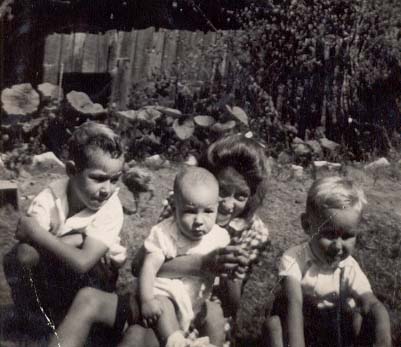
The Caudill’s children in 1947 included Bobby Gene Caudill, Thelma Fern Caudill holding Danny L. Caudill, and Billy R. Caudill.
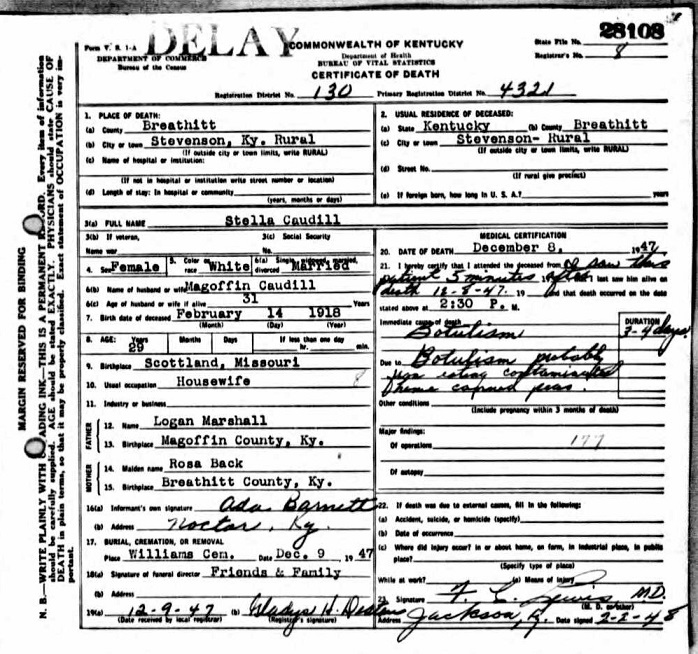
They loaded her into a vehicle and started for town. She went completely unconscious, stopped breathing, and died in the seat of the truck near the mouth of Quicksand before they got her to help in Jackson. They rushed her on to Jackson to the office of Dr. Farren C. Lewis in the Jefferson Hotel, but there was nothing they could do to revive her. She was pronounced dead at 2:30 p.m. Dr. Lewis identified the cause of her death on the death certificate as “Botulism, probably from eating contaminated home canned peas.” Stella Marshall Caudill, the mother of five young children, was dead at 29.
The Kentucky Death Certificate for Stella (Marshall) Caudill was signed by Dr. F. C. Lewis.
Dr. Lewis warned the family to keep an eye on anyone who ate the peas on December 5, but no one showed any signs of trouble. That changed shortly after 7:00 p.m. on Monday night, December 5. Just five hours after the passing of his mother, Danny Caudill started having abdominal cramps and complained of a headache. The next morning, he was taken to Jackson in the same vehicle that had carried his mother the day before. Dr. Lewis sent him to Good Samaritan Hospital in Lexington, where doctors and nurses treated him for three days. Despite the best efforts of the medical staff, three-year-old Danny Caudill died on Friday, December 11.
Magoffin Caudill went to Lexington and stayed with Danny until his young son passed. While sitting at his bedside, news came from Noctor to the hospital on Thursday night that two more of his children were exhibiting symptoms of the same condition. Eight-year-old Bobby Gene and Billy Reed, six, started showing similar symptoms as their brother late in the evening on Thursday, December 11. Family members caring for the boys contacted Dr. Lewis to report the symptoms. He made calls in an effort to find a facility to treat the boys with little luck initially. After multiple calls and contacts to hospitals in the state (6 total, according to one source), he managed to get them admitted to Children’s Hospital in Louisville for treatment.
A taxi cab from Jackson hurried to Noctor and loaded the two suffering boys into the back seat for the long ride over Frozen Mountain to the medical treatment, which many hoped could save their lives. The unusual story of tragedy was picked up by the Associated Press after rumors circulated in Louisville of the rare case of food poisoning. Articles about the sad fate of a Breathitt County family started appearing with updates on the condition of the two young children at Louisville.
Food Poisoning Kills Mother, Son; 2 others Ill
Breathitt County Family Reported VictimsOf Home-Canned Peas; Animal Antitoxin Used
A Breathitt County mother and one son are dead, and two other sons seriously ill in Children’s Hospital here, victims of food poisoning from home-canned peas.
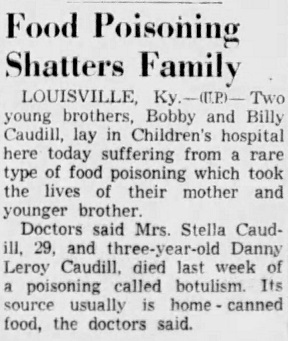
Mrs. Stella Caudill, 29, and 3-year-old Danny LeRoy Caudill, died last week of a rare and extremely severe type of poisoning called botulism. Its source, doctors said, is nearly always home-preserved food.
Physicians at Children’s Hospital said Bobby Gene Caudill, 8, appears to be recovering, but described the condition of his brother, Billy Reed, 6, as still critical.
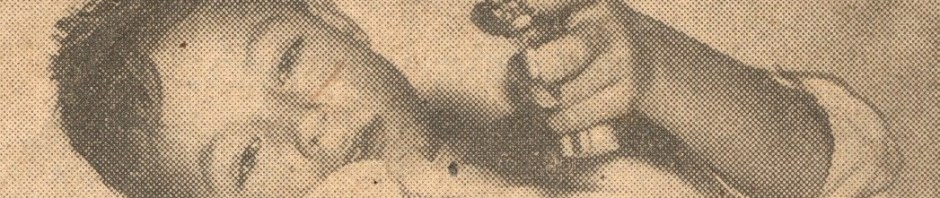
Bobby Gene Caudill played with his toy pistol while doctors administered medication to him at the Louisville Children’s Hospital.
Father Haggard. Stunned.
Haggard and stunned, the father. Magoffin Caudill, 34, told how members of his family were stricken after eating home-canned peas for lunch Friday, December 5. Mrs. Caudill became sick the following day and died Monday, December 8, en route to a Jackson, Ky., physician. The family lives on a branch of Quicksand Creek near Noctor, Ky.
The Louisville Courier-Journal, December 16, 1947, page 1.
Danny LeRoy displayed symptoms of the disease Monday night after his mother’s death, and was taken the next morning to Jackson, Ky. He later was moved to Good Samaritan Hospital, Lexington, where he died last Friday.
Meantime. Bobby Gene and Billy Reed fell ill Thursday. Caudill said relatives who were caring for the boys were unable to obtain accommodations for them in overcrowded hospitals at Lexington and Paintsville. The youngsters were brought to Louisville in a taxicab Friday, while their father was still at the deathbed of their younger brother.
Minutes after their arrival here, their ailment was diagnosed, and a frantic search begun for an antitoxin. So rare is botulism that drug companies here reported they had none of the serum and telephone calls were made unsuccessfully to medical centers in Chicago, Cleveland, Philadelphia, Columbus, Cincinnati, and Kansas City.
A last-resort call to a veterinarian’s supply firm here finally turned up a form of anti-botulism serum used on animals. Aware that this previously had been administered safely and effectively to humans, physicians at Children’s Hospital immediately started injecting it into the Caudill youngsters. The youths “responded favorably.” the doctors said, and the treatment was continued several days.
Others Escaped.
The father, a farmer, was working part time at a nearby mine and failed to go home for lunch the day his wife served the tainted food. Two other children also escaped illness. One a 14-month-old baby was too young to eat the canned peas, and another. an 11-year-old girl, refused to eat because she had been feeling ill.
Physicians at Children’s Hospital were puzzled over the fact that while all victims ate the peas at the same time, they became ill after varying intervals. State Health Board technicians have been sent to the Caudill home to test the suspect food.
Botulism sometimes results, physicians said, when home-canning containers are not sufficiently germ free.
The Louisville Courier-Journal, December 16, 1947, page 1
The doctors and nurses at the Children’s Hospital in Louisville continued to treat the two boys, using the anti-botulism serum gathered from veterinarians across the region. Bobby Caudill showed immediate signs of recovery, and doctors were pleased with his progress when they spoke to reporters on December 16. The prognosis for Billy was not as good. It took much more attention to save the life of Billy Reed Caudill, but the medical experts managed to do just that. After a long recovery, both of Magoffin Caudill’s food-poisoned sons walked out of the Children’s Hospital in Louisville to return to their shattered lives in Breathitt County.
The Louisville Courier-Journal, December 16, 1947, page 1
A few spoonfuls of peas shattered the happy Christmas the Caudill family had hoped for in 1947. Stella L. Caudill and her son, Danny Leroy Caudill, were buried by the family in the Caudill section of the Williams Hill Cemetery just above Slate Branch.
Magoffin Caudill stayed by his sons’ bedsides in Louisville. He brought them home in 1948 after they were released from the hospital. He mourned the loss of his young wife and son. He later married Pearl Blevins and had two additional sons, Robert and William. He died on June 10, 1999, and was buried at the Jackson Cemetery. His second wife, Pearlie, followed him in 2000.
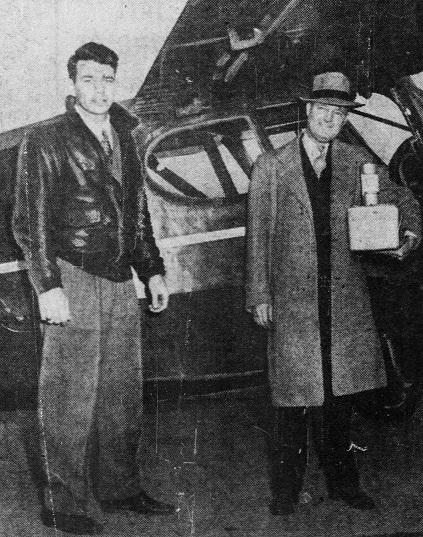
READY TO LEAVE Bowman Field with serum for Knox County food-poisoning patients are pilot Edgar T. Youree, left, and Martin T. Niswonger. State Health Department.
Following the Caudill cases, medical facilities across the state started to stock medication and serums used in the treatment of food poisoning victims. A poisoning case in Knox County in 1949 cited the Caudill case as a major factor in the preservation of life for four patients in a case treated at a Pineville Hospital. Sadly, three other patients died before the cause of the ailment was diagnosed. Thanks to the Caudill case, hospitals in Cincinnati, Louisville, and New York sent serum by airplane and made it in time to save all four patients.
Since the terrible events at Noctor in December 1947, hundreds of patients have been saved across the state because of the horrible accident that forever changed the lives of the Breathitt County family of Magoffin Caudill.
Thanks to Maxine (Caudill) Back and Susan Pugh for the use of some of the Caudill Family photos.





 Bookie on the Trail