Jackson has not always been at the forefront of innovation. In fact, sometimes, we run a little behind the rest of the state and world. In 1954, the United States Supreme Court desegregated the nation’s schools unanimously on a 9-0 vote. Schools across Breathitt County soon complied with the decision in 1955 and 1956. The “Colored Only” signs were removed from public places in Jackson in 1958. One segment of Jackson’s past lagged even further behind.
Mayor Leonard Noble
The Jackson Police Department had a long and often violent past. Several officers fell to criminals’ guns, and many more wore the wounds from a town living up to its violent reputation in the heart of “Bloody Breathitt.”
A large community of African-American citizens in the city lived on Hurst Lane and in other areas of the town but were not fully represented on the Town Council (later City Council) or on the police force. There were very influential members of the African-American community who contributed to Jackson’s development throughout its history, including Henderson Calamese, Jason Fox, and Robert “Bob” Wallace.
The lack of representation in the official leadership of the community ended in 1976 when progressive Jackson Mayor Leonard Noble and Jackson Police Chief Lewis Watkins chose a black man to be Jackson’s first African-American public official and Jackson’s first and only black police officer.
Jackson Police Chief Lewis Watkins
During the regular meeting of the Jackson City Council on August 9, 1976, the Council discussed their regular business. They heard from Sam Callahan, who urged the Council to annex his property on the outskirts of town known as the King’s Ridge Development. “I have already sold eleven lots to three individuals,” Callahan told the Council. He reiterated that this was not a “fly-by-night project” and that it would also include a request to the Housing and Urban Development Administration (HUD) to construct affordable housing on another portion of the property.
Near the end of the meeting, Jackson Police Chief Lewis Watkins addressed the Council and asked the city’s representatives to hire a new officer. “We are short on patrolmen,” Watkins told the Council, “We need to hire at least one and eventually another one to replace the two we have lost in the last few months.” Chief Watkins mentioned two possible candidates for hire, including a retired Navy man who was now living in the city. When asked, Chief Watkins recommended the Council hire George Hopewell.
Reporter Beulah Coomer wrote in the August 12, 1976 edition of The Jackson Times that “George Hopewell was promptly hired as a policeman on a unanimous vote by the Council” after a discussion of about three minutes. Her article about the Council meeting and a special article detailing the addition of Hopewell to the Jackson Police Force appeared on the front page of the paper the following week.
City Hires First Black Policeman
Patrolman George Hopewell, Jackson’s first black police officer, started his new job Monday night.
JPD Officer George Hopewell
A native of Winchester, Hopewell attended Olive High School. He is a veteran of the United States Navy, having completed sixteen years ago, eight years of overseas duty.
Hopewell was employed by Sears in Lexington for 16 years. His wife, Charlena, moved to Jackson two years ago to be with her mother, Mrs. Bascom Caywood, after her father died.
Charlena Hopewell was the first black graduate of Jackson High School and was honored for this distinction at this year’s Alumni Homecoming.
The Hopewells, along with their five children, Felita Florence, 22, Anthony, 16, Teresa, 14, Donna Jo, 11, and Maurice, 5, live at 920 Highland Avenue.
Patrolman Hopewell will be working on the night shift. Mayor Leonard Noble commented, “I feel the city is very fortunate to have George on the force.”
The Jackson Times, August 12, 1976, page 1.
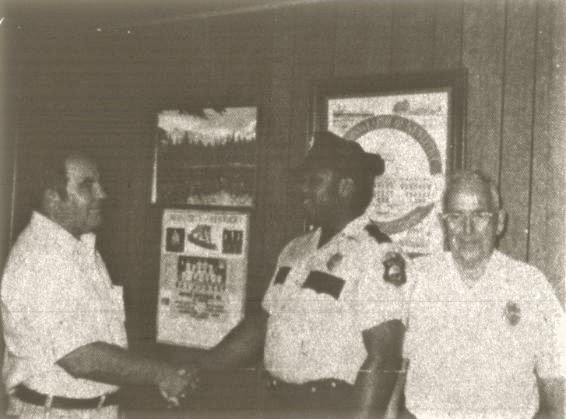
Mayor Leonard Noble shook hands with Officer George Hopewell as Chief of Police Lewis Watkins watched Hopewell’s swearing-in.
Louise Hatmaker, Editor of The Jackson Times, mentioned the hiring of George Hopewell in her “Potpourri” editorial on page two in the August 12, 1976 edition of The Times.
Over the next year and a half, Hopewell served as a member of the Jackson Police Department under Chief Watkins. He made numerous arrests and was responsible for most of the police department’s interactions with the African-American community on Hurst Lane and South Jackson.
George Hopewell (left) with members of the Jackson Police Department in November 1976, including Ray Oaks, Jim Ingram, David Back, George Lee, Austin Rogers, and Chief Lewis Watkins (right).
As de facto liaison to minorities in the city, he worked to strengthen community ties despite the resentment of many in the community who opposed his hiring because of racial biases. He continued as a patrolman from 1976 and on into 1978 before a series of bad financial decisions forced him to resign from the Police Department.
Jackson Police Officer George Thomas Hopewell, Jr.
George Hopewell, his wife, Charlene (Caywood) Hopewell, and their children, left Jackson and moved to Winchester, Kentucky, around 1979. They lived in Winchester until his death on March 27, 2012. He was buried in the Camp Nelson National Cemetery near Nicholasville in Jessamine County, Kentucky.
The grave of George Thomas Hopewell, Jr. at the Camp Nelson National Cemetery in Jessamine County, Kentucky – Source
George Hopewell remains the only black officer to serve the people of the City of Jackson as a member of the police department.




 Bookie on the Trail