By Stephen D. Bowling
The editors of The Jackson Times filled the front pages of their newspaper each year with greetings and wishes for a Happy Thanksgiving. Large banners at the top of the newspaper frequently expressed its appreciation for its many readers and advertisers. They urged their readers to celebrate the venerated American tradition started long ago by the first settlers of New England.
The men and women who “laid up” the newspapers and later whacked away on the limo-type machines, occasionally inserted graphics and clip-rated images of the Pilgrims walking to church or carrying a large turkey home from the kill. Articles expounded on the historical beginning of the holiday and the cooperative dinner enjoyed by settlers and Native peoples alike.

One article, tucked away on page 5 of the Thursday, November 27, 1958 edition of The Times, told a different story. The short passage, formatted in a single column and wedged between a Sunday School lesson and an announcement that the state would spray for mosquitos, was largely overlooked and ignored by those who preferred the Puritan narrative. The article, probably produced and syndicated in many newspapers across the country, received little notice or mention in Jackson.
Puritans Did Not Originate Thanksgiving
The Pilgrims would have been choked to their shoe buckles on December 13, 1621, if they had known that their day of thanks was to become a yearly national holiday celebrated by millions of people in the United States and Canada.
For the Pilgrims were dead set against “annual” holidays. And refused to celebrate even Christmas and Easter.
According to research experts with The World Book Encyclopedia, the Pilgrims referred to the religious holidays of the Church of England as “Roman corruptions.” They believed in celebrating only when Providence granted them a particular blessing.
As if to prove their disdain for yearly calendar-fixed celebrations, the Pilgrims did not have a thanksgiving celebration the next year. However, other New England colonists picked up the idea and held “thanks days,” usually around the end of November.
The Pilgrim-inspired holiday is today a joyous family day celebrated with big dinners and happy reunions, but the history of the holiday in the United States has been fraught with argument.
In 1789, a resolution was presented by a member of the new Congress proposing that a day be set aside to give thanks for the Constitution. The resolution was finally adopted, but there was much opposition by those who believed that Federal Government was meddling in a matter that should be the concern of the individual states. Thomas Jefferson called the Government-proclaimed holidays a “monarchical practice” and ignored thanksgiving during his eight years in office.
Mrs. Sarah Hale, editor of Godsey’s Lady’s Book, worked for 30 years to promote the idea of a national thanksgiving day. Mrs. Hale had a double-barreled attack – she printed editorials promoting the idea and also included tempting recipes for Thanksgiving delicacies.
In 1863, Lincoln proclaimed that the last Thursday in November would be Thanksgiving Day. Each year afterward, the President of the United States formally proclaimed that Thanksgiving should be celebrated on the last Thursday in November.
However, some descendants of the original New England Puritans refused to observe the holidays, claiming that Thanksgiving should be inspired by the Deity, not by politicians.
The Jackson Times, November 27, 1958, page 5.
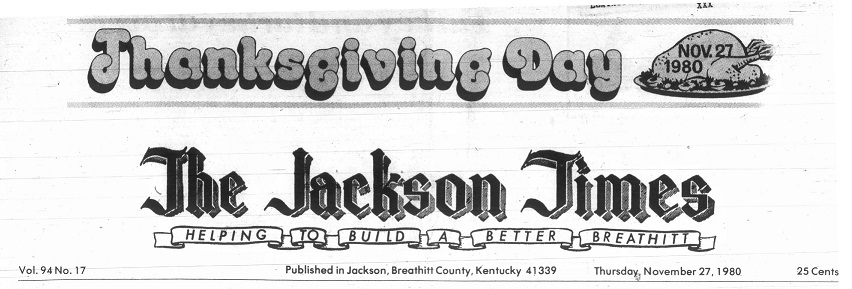
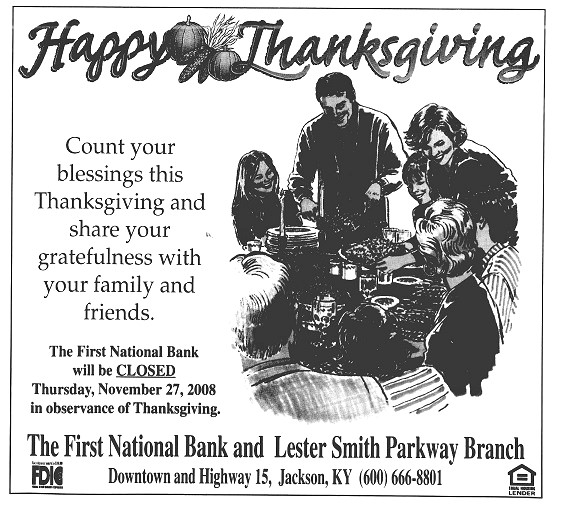
Despite the 1958 article, Thanksgiving greetings in The Jackson Times, Breathitt County Enquirer, Breathitt County Banner, Breathitt County Voice, Breathitt County Advocate, and several other newspapers that published Breathitt County’s news in the years to follow became standard advertising. The number of greetings continued to grow and really hit a peak in the 1990s and early 2000s.

The local papers continued the tradition of publishing the annual greeting and advertisement that perpetuate the “Puritan foundation” for the Thanksgiving holiday as taught in most elementary and high schools. The paper also published proclamations and Thanksgiving wishes that followed the intent of the 1958 article to focus the holiday back on the Deity rather than the politicians and profit, as the article indicated.
A joint resolution, issued and published in The Jackson Times by Breathitt County County Judge William Turner and Jackson Mayor Charles H. Davis, summed up the thanks they offered to God for the year 1951. They noted that “no great flood damage, fire, famine or pestilence” had visited the county or city. They were thankful for health, prosperity, and comfort. Most of all, they were thankful for the blessing of safety for local boys “in a far-away land fighting for freedom” during the Korean War. Together, they expressed their appreciation for God, who “gave away his only son, Jesus Christ, to die on a cruel cross for our eternal salvation” and for the “uncounted blessing” during the previous year.

The joint proclamation issued by politicians in 1951 helps us define the real purpose of Thanksgiving. It is not the food we eat or even the people we choose to eat with. The real reason is to remind us to “set aside a day of Thanksgiving” and to give “Praise to God for his many and manifest blessings.” Let us all pause to thank God for his many blessings as we celebrate this day.
Happy Thanksgiving to you and your loved ones!!
© 2023 Stephen D. Bowling

 Bookie on the Trail