
By Stephen D. Bowling
This is the sixth installment of a series of articles that follow the development and success of the football team at Breathitt High School.
“I promise you, it will be done.” Eugene Sebastian smiled as he told those gathered at the 1973 Football Banquet about his desire to build a football stadium. He said that he did not know where or how it would be built. He might have bluffed the crowd just a bit, and he certainly held back the details of a secret project he was exploring.
For the previous six months, Sebastian and a few others associated with the Breathitt County School Board accomplished a miracle in Breathitt County- they kept a secret. As far back as January 1973, there had been an idea that was kicked around in private. If the Breathitt County School System could expand the physical education program by adding football and maybe restarting baseball, the state would approve the addition of several new facilities. More than a year before, members of the community helped start and fund a football program, but the finances were not available for the Board of Education to build a stadium. Mr. Sebastian, however, had more pressing issues.
In 1972, the facilities survey team from the Kentucky Department of Education completed their review of the overcrowded classrooms and structures in Breathitt County. The team identified several issues, but none greater than the need for an upgraded middle school. Little Red, the only middle school in the county, had long since outlived its usefulness. Rotten boards, dangerous steps, leaking roofs, and outdated coal-burning heating stoves did not make education easy for its 350 students. The state’s survey team recommended the demolition of Little Red and the construction of a modern junior high school.
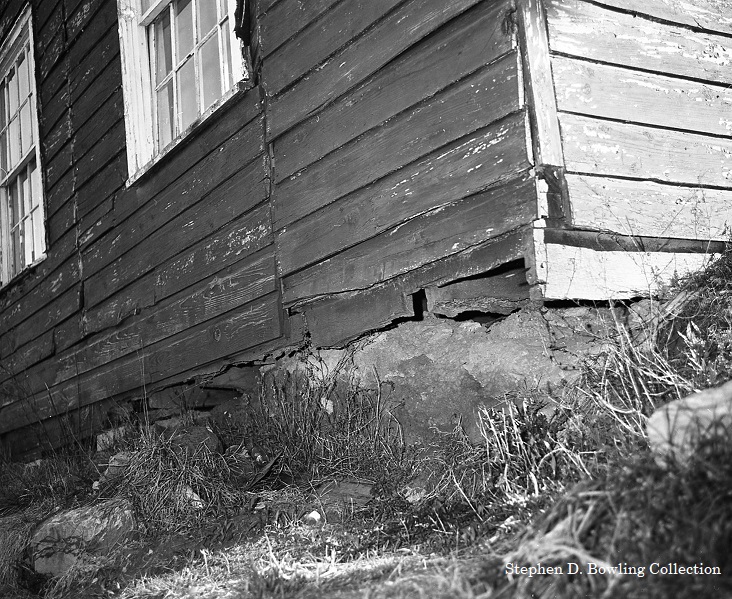


Mr. Sebastian and the Breathitt County Board of Education saw an opportunity to combine the two projects into a local option tax effort to fund both. The special levy would require approval by 51% of the votes during a special election. Leaders were not sure that the county’s voters would approve an increase of their own taxes voluntarily. The secret project was researched, and officials determined that there might be enough community support, so they moved forward at a clip.
The Breathitt County School Board of Education met in Special Session on March 14, 1974, to discuss the possibilities and look at preliminary sketches for a proposed junior high school and two athletic fields. The Board met at 9:30 a.m. and quickly voted to begin the process. According to the proposal they approved, the Board would ask the community to vote for a “special building tax ranging from five cents to 13 cents per $100 of assessed valuation” for a period “of not more than 25 years.” The petition asked that the measure be placed on the ballot for a special vote in April 1974. The Board of Education approved the plan unanimously after a brief discussion.
Mr. Sebastian and the Board of Education adjourned the meeting, signed a few required documents, and hurried across the street to the Breathitt County Courthouse. At 10:00 a.m., the Breathitt County Fiscal Court gaveled into session to receive and discuss the Board’s request for an election. The coordinated meetings were not an accident, and the Magistrates had been carefully briefed to ensure that everyone understood what was at stake.

The Fiscal Court listened as Mr. Sebastian presented information about the referendum process and discussed the proposed tax. Louise Hatmaker of The Jackson Times described the proposal as a way to “supply the system with funds to pay off school revenue bonds to construct a badly needed Junior High School to replace Little Red” and build two new athletic fields. Sebastian noted that the Kentucky Department of Education deemed Little Red as “not worthy to repair.” The initial proposal also added an outdoor classroom, an arboretum, and an indoor swimming pool for LBJ Elementary School.
The plan called for the new junior high school to be constructed adjacent to the high school on the site occupied by Little Red and would accommodate 650 students. The proposal also called for a football/baseball field near LBJ and a new track/football field with a stadium on the campus of Breathitt High School. A proposed administration building on Court Street was added and would also be built using funds generated by the proposed tax.
Sebastian told the members of the Fiscal Court that the proposed 13% tax would not represent a tax increase. “The current tax of 13% levied to construct the new courthouse will expire this year,” Sebastian noted. “Our request will replace that and voters will not see a tax increase.” The Superintendent discussed the tax initiative that voters in the City of Hazard approved in the Fall of 1973. “I’m sure our people will be willing to do as much for our children,” he said.
County Judge Nim Henson and Magistrates Woodrow Salyers, Bill Watkins, Han Carpenter, and Blackburn Griffith listened as Sebastian made his case for the more than $1.5 million dollar construction effort. He asked that the special election be held “as soon as legally possible.” Under Kentucky law, the earliest date the election could be held was April 6, 1974, but the special election had to be approved by the Fiscal Court first.
The Fiscal Court met later that afternoon on March 14, 1974, to vote on the proposed measure after some discussion outside the courtroom. Judge Henson and three magistrates who favored the proposal attended the meeting, while other officials, who opposed, chose not to come. County Attorney William P. Bach read the entire petition to Magistrates Blackburn Griffith, Han Carpenter, and Bill Watkins. The Magistrates asked a few questions, mostly to understand the timeline and how long the tax would be in place. “It could go on forever. I’m not for it if it’s indefinite,” Griffith said. Superintendent Sebastian and County Attorney Bach answered the Magistrates’ questions. The Court indicated that they did not favor the measure, but County Attorney Bach noted that the Court did not have much “leeway” in the matter and that it was “mandatory” for the Court to place the matter on the ballot.
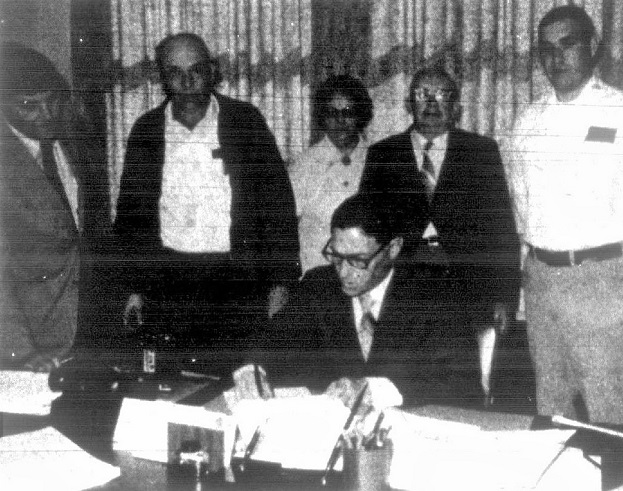
Magistrate Han Carpenter moved that the petition be approved, and Bill Watkins seconded. All three magistrates voted in favor as they explained, “Since we have no choice but to let the people decide.” Judge Henson, with the three magistrates gathered around, signed the official proclamation of an election shortly after the meeting adjourned.

Both sides of the issue fought hard in the two weeks between the approval of the special election and election day. The Jackson Times was filled with paid advertisements and editorials praising the efforts to modernize the school system and others who believed that the taxing rates in Breathitt County were already too high. Many people in the community wanted to let the Courthouse tax drop and wait “a couple of years” for the school tax. “We need a break,” one voter wrote, “Give us some time to breathe.”
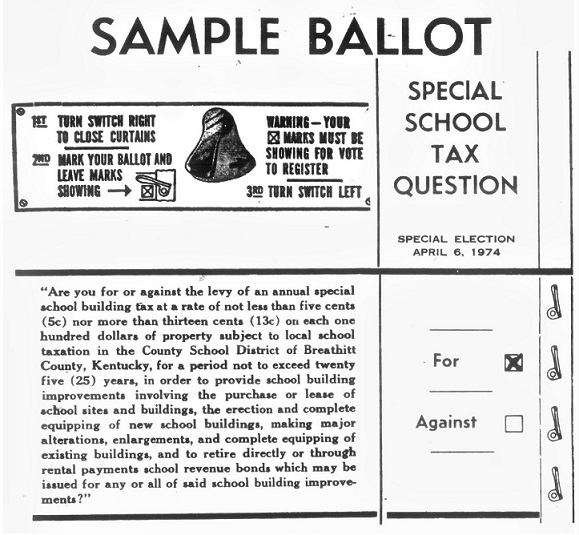
The Jackson Times printed an advertisement on page 10 of the April 4, 1974 edition in support of the ballot measure. The long article by Superintendent Eugene Sebastian listed the five major points in support of the voluntary tax, including the condition of Little Red, classroom overcrowding, expansion of the athletic program, and the possibility of new opportunities for students in our “ever-changing society.”
“I am convinced that the future of our youth is the first concern of the citizens of Breathitt County,” Sebastian wrote. “We have a golden opportunity to make a new junior high school a reality.” He asked the community for its support and their affirmative vote on election day. “Let’s make April 6, 1974, a day that the boys and girls of Breathitt County will long remember by your vote FOR the proposed tax levy which will ensure schools for our children.”
Mr. Sebastian’s reasoned and passionate plea certainly swayed voters, but the words printed next to his statement swayed many more. In large black type, the paid advertisement included “Marie R. Turner Says Vote Yes On Breathitt County School Bonds.”
As the election approached, the attention of the county and nation turned away from the tax and focused on the safety of relocated Breathitt County relatives in other states. On April 3-4, 1974, more than 148 tornadoes swept across 13 states, including all of the Ohio Valley, killing an estimated 335 across the country. Kentucky, Ohio, and Indiana were the hardest hit, with 159 deaths, more than 4,000 injuries, and nearly four hundred million dollars in damage. The Super Outbreak hit Xenia and Salyer Park near Cincinnati hard. In the days that followed, many Breathitt County residents tried to make contact with family members in the North.
Two days after the Outbreak, Breathitt County went to the polls. Higher-than-expected turnout saw 1,481 voters express their opinions on the tax issue. When all of the precincts reported their totals, voters in Breathitt County approved the County School Tax Levy by a 2-1 margin. The final tally sheet showed that 1,041 voters approved the modernization effort, and 440 voted against the tax. Every precinct voted in favor of the tax except Oakdale, with 27 votes for and 29 votes against the tax.

Superintendent Sebastian and the Board of Education wasted no time and went to work on the plans for the new facilities. The plans were completed and quickly approved by the Board. They met in Special Session on January 6, 1975, to advertise the bids for the football stadium construction. Advertisements were published in newspapers across the state. The deadline was set for 10:30 a.m. on February 7, 1975, for construction bid submissions.
The Board met in special session and opened bids “for furnishing all materials and labor and performance of work for the construction of Breathitt County High School Athletic Facilities and the Breathitt County Middle School.” Of the five contractors, Hacker Brothers Construction of Corbin was the low bidder at an estimated cost of $2,344,009 for both projects. The contract was not awarded that day, and the Board asked for more time to review the bids. Hacker estimated that the football field and stadium alone would cost $505,206 to construct as designed.
After more than a week of consideration, the Board voted to reject all the bids and open the bid process again. They set March 6 at 2:00 p.m. as the deadline for the submission of new bids and the date for opening the submissions. The Board worked closely with the Department of Education to reword the bid announcement to avoid any misunderstanding and to align the costs with the anticipated tax revenues. When the bids were opened on March 6, Hacker Brothers Construction again had the lowest bid totaling $1,827,477 for both projects. The Board of Education approved the low bids and submitted them to the Department of Education. After approval, the Breathitt County Fiscal Court sold school revenue bonds for the Board. Construction started, and Superintendent Sebastian said, “Only the weather can hold things up.”


On May 15, 1975, The Jackson Times included a dark photo of the work that was underway in Jackson’s “$10 Million Construction boom,” which included the new Highway 15 By-Pass project from Jackson to Vancleve, the construction of the Prestolite factory, the construction site for a new factory in South Jackson by Mt. Top, Inc., and the new BHS Football Stadium. The paper also touted the new location of the middle school on the Panbowl Farm near the LBJ School and the new office of Falcon Coal on Highway 15 South.
By the time Spring training started for the BHS football team, the new stadium was taking shape. Construction slowed briefly as crews removed the in-ground gasoline storage tank that they “forgot” was under the playing field. After the tank’s removal, work progressed rapidly during the dry summer, and contractors announced that the new stadium would be ready for home games that fall. As construction continued, the Board of Education announced that the first home game at the stadium was scheduled for October 9. Everything was on track. Then the fall rains came, and progress slowed.
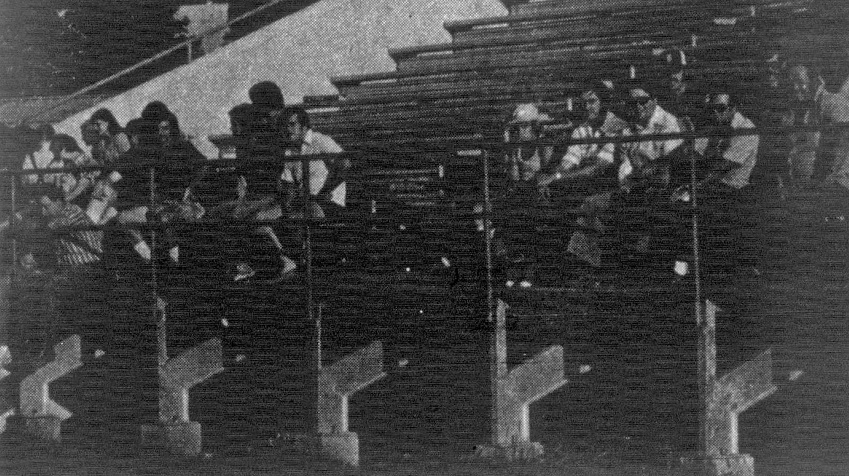
The October 9th game was moved from Breathitt County to Estill because work was not finished on the facility. The local football fans watched for some glimmer of hope for a home game during the 1975 season, but none came. October 16 passed, and before long, it was November. Breathitt played their final game on November 7 at M. C. Napier and lost by a score of 28-26. The 1975 season ended without a home game. It would be more than 8 months before the Breathitt High School Football Stadium was officially opened in July 1976.
The first official event held at the new football stadium was a religious service sponsored by the Ministerial Association and fireworks provided by Jaycees on July 4, 1976. Rev. Lee Hubbard delivered the message, and hundreds watched as the sky was filled with fireworks in honor of the nation’s 200th birthday. The first football game would not be played until August 27, 1976, when Breathitt defeated the Leslie County Eagles by a score of 6-0.
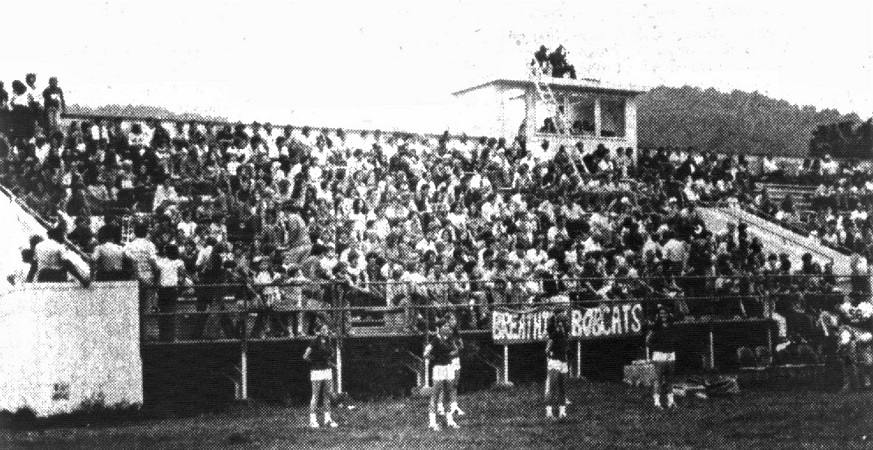
It is unreported if much “third down thunder” was heard during opening night, but the closeness of the stadium would become a part of the lore of the river bank. The stadium hosted Breathitt’s home games from 1976 through the 1997 season and was replaced with the current covered stadium. The last football game played at the old BHS stadium was a 53-6 whipping of East Carter for Breathitt’s 42nd straight win from 1995-1997.

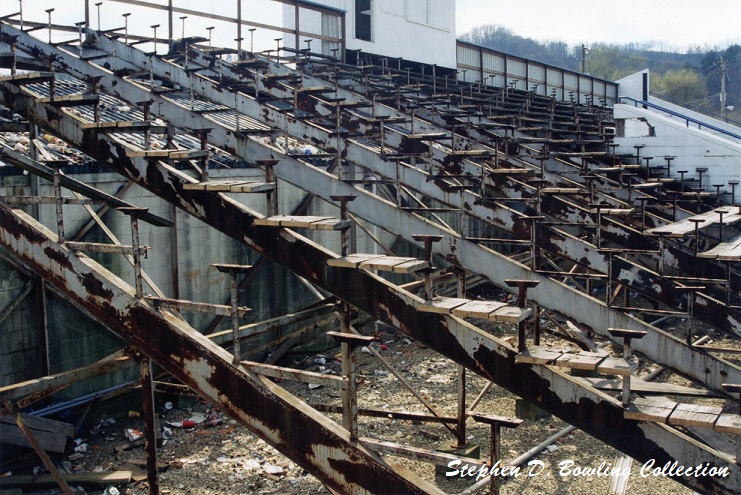
There will be many more victories to come in the current BHS Stadium. Fans appreciate the cover on rainy nights and the view afforded by the new facility. But if you are quiet and listen very hard on most Friday nights in the fall on the river bank, you just might hear a cheer about a greasy porkchop and the low rumble of rattling tin.

© 2023 Stephen D. Bowling

 Bookie on the Trail
Wonderful articles! It has lots of local information that people are really engaged into!
I do have a question: “Where did you aquire some of the older band photos that show the football field?” I just wanted to know to maybe aquire permission in the future to use/show.
Thank you!
LikeLike